
Every article that ranks for "how long does it take to sell a house" answers a different question than the one you are asking. They quote a national median for days on market — the stretch between the listing going live and an offer being accepted — and then stop. Zillow does it. Opendoor does it. So do the agent blogs from Texas, Ohio and Maryland that fill out the first page.
Days on market is one of five clocks. It is also the only one of the five where a national median is close to useless in the Bay Area, and it is not the clock that produces the horror stories. Here is the whole calendar, in the order you will actually live through it.
The honest answer, up front
From the day you decide to sell to the day the money is in your account, a conventional Bay Area sale with a financed buyer typically runs two to four months, and longer if anything goes wrong. That is a typical range drawn from the houses we see, not a measured statistic — your own calendar depends on which of the stages below apply to you. A direct cash sale runs 7 to 21 days from accepted offer, because it deletes two of the five clocks entirely.
The gap between those two ranges is not marketing. It is a specific list of steps, and you can go through it line by line below and work out which ones apply to your house.
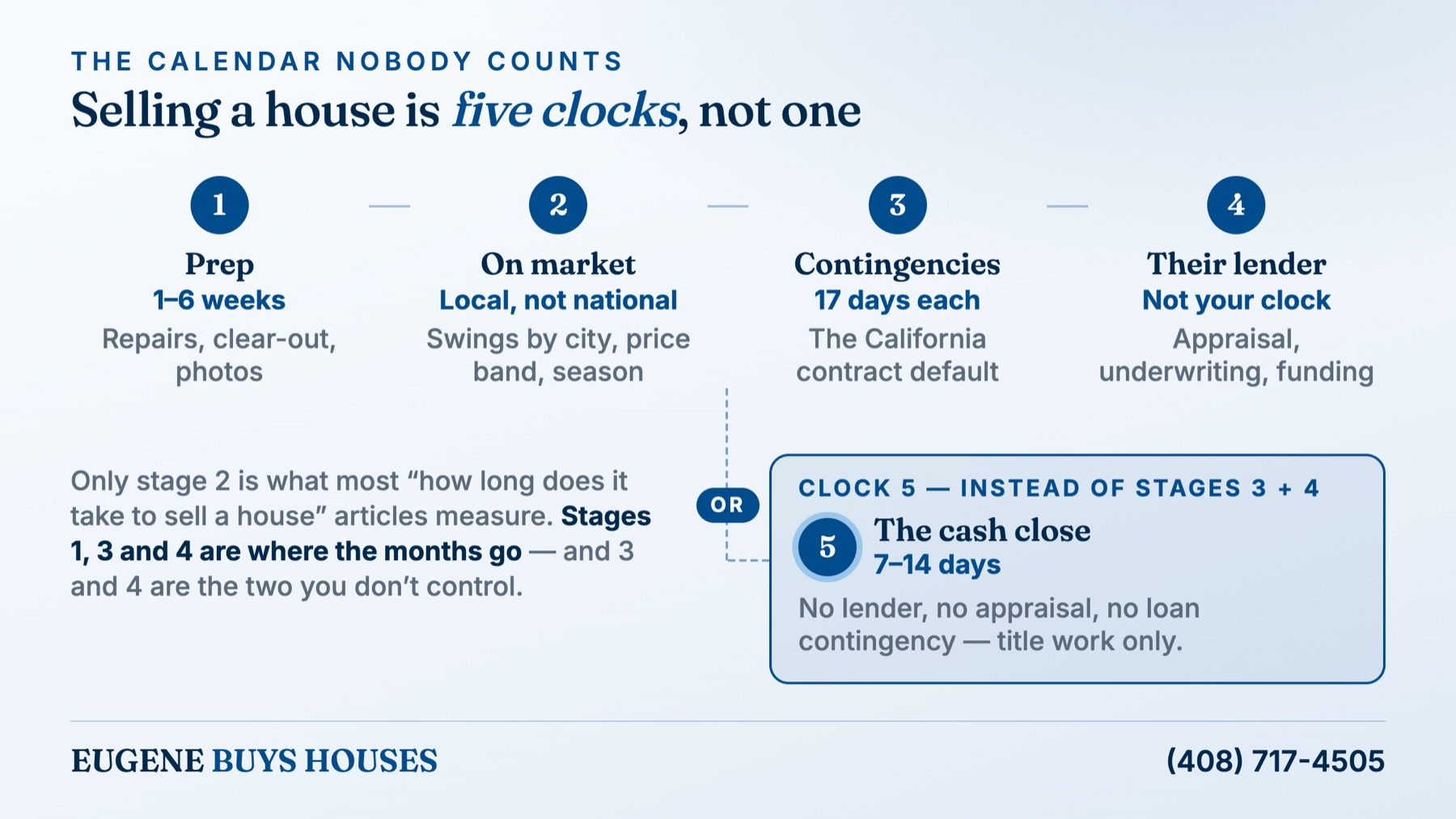
Clock 1 — Prep: one to six weeks, and it is all yours
Nothing in the national data counts this, and for a lot of Bay Area sellers it is the single longest stage. Before a photograph is taken you are dealing with:
- Clearing the house. Thirty years of belongings, a garage, a shed, sometimes a storage unit. For an inherited or long-held property this alone is often three to six weeks.
- Repairs and paint. Not a renovation — the things an agent will insist on. A contractor who can start next week is rare; six weeks out is normal.
- Disclosures. California's Transfer Disclosure Statement and Seller Property Questionnaire, plus the Natural Hazard Disclosure report. Filling these out honestly takes real time and, on an older house, real thought.
- Pre-listing inspection, if you are doing one. Scheduling plus the report itself, typically a week or two.
- Photos and marketing. A few days after the house is ready, not before.
If you would rather skip all of stage 1 — and for a house with condition problems that is often the whole point — selling as-is in California is the mechanism, and it removes this stage entirely rather than shortening it.
Clock 2 — Days on market: look up your own micro-market
This is the number everyone quotes, and the one worth the least. A national median blends wildly different markets together — to take two illustrative price points, a $240,000 house somewhere in Ohio and a $1.6M house in San Mateo (both are round examples, not quoted figures) sit inside the same average. And the Bay Area is not one market either — it is dozens. Days on market here swings hard on four things:
- Price band. The entry-level band in a given city and the top band in the same city behave completely differently.
- City and micro-neighborhood. A well-priced house in a school-driven Fremont neighborhood and a comparable one in a slower Concord pocket are not the same listing.
- Condition. Turnkey moves. Deferred maintenance sits, gets a price cut, then sits again.
- Season. Spring listings and the week before Thanksgiving are different businesses.
So rather than give you an invented figure, here is what to do instead: ask your agent for median days on market for your city, your price band, in the last 90 days — and specifically ask whether that median counts relisted properties, because a listing that fell out of escrow and came back often restarts its day count and quietly flatters the number. That one question will tell you more than any article, including this one.
Clock 3 — Contingencies: 17 days each, by default
Here is where the calendar stops being about your house and starts being about the contract. On California's standard residential purchase agreement, the buyer's investigation, appraisal and loan contingencies each run on a default period of 17 days from acceptance unless the parties write in something different.
In practice, once an offer is accepted:
- The buyer's deposit goes to escrow within about three days.
- Inspections get scheduled — general, and then whichever specialists the general inspector recommends. Roof, sewer lateral, foundation, pest. Each specialist is a separate appointment on someone else's calendar.
- The reports come back. This is where renegotiation happens, and it is the most common reason a sale that looked like 30 days becomes 50.
- The appraisal is ordered by the buyer's lender, not the buyer. If it comes in under the contract price you are into a second negotiation, and sometimes a third.
Every one of these is a point where the buyer can ask for money or walk. We wrote up the money side of that renegotiation in how much it costs to sell a house in the Bay Area — repair credits are one of the largest and least predictable line items on the whole sale.
Clock 4 — Their lender: the clock you do not control at all
Even with a cooperative buyer and a clean inspection, a financed sale waits on an underwriting department. The sequence is: application, appraisal, underwriting, conditions ("we need one more bank statement"), clear to close, the federally required three-business-day waiting period after the closing disclosure is delivered, then funding, then recording.
Thirty days is the standard escrow written into most offers. It is a target, not a guarantee, and it slips for reasons that have nothing to do with you — a buyer changing jobs mid-escrow, an appraisal that needs a second review, a condo HOA questionnaire that takes ten days to arrive.
And this clock carries the one risk that resets everything: the deal that dies at day 25. The buyer's loan is declined, or they walk during the inspection window, and you are back on the market — only now with a property that shows a broken escrow, having lost nearly four weeks and paid another month of mortgage, taxes, insurance and utilities on a house you have mentally already sold.
Clock 5 — The cash close: 7 to 21 days, and why
This one is not a fifth step at the end of the other four. It is the alternative to clocks 3 and 4 — you take this path instead of them, not after them. A direct cash purchase does not run faster because someone is hurrying. It runs faster because clocks 3 and 4 do not exist:
- No lender — no underwriting, no conditions, no closing-disclosure waiting period, no funding queue.
- No appraisal contingency — the buyer has already decided what the house is worth to them, at their own risk.
- No loan contingency — the largest single cause of fall-throughs is simply absent.
- No repair negotiation — an as-is purchase prices the condition into the offer up front instead of relitigating it after an inspection.
What is left is title work and escrow mechanics: the preliminary title report, payoff demands from your lender and any lienholders, clearing anything unexpected the title search turns up, signing, funding, recording. That is genuinely a 7-to-14-day process on a clean title, and the thing that most often extends it is not the buyer — it is a lien, a probate, an unreleased old mortgage or a title defect. We covered the paperwork side of that in what a real cash offer contains.
The trade-off is entirely about price, not speed, and it is worth being blunt about: the cash number is below what a patient open-market sale would fetch. Whether that discount is worth the two to four months a listing typically takes is the actual decision, and we set both sides out in how much cash home buyers really pay and cash offer versus listing with an agent.
What makes your house slower than average
Timelines are not distributed evenly. These are the factors that reliably add weeks — to a listing, and in some cases to a cash sale too:
- Tenants in place. Notice periods, access for showings, and in some cities just-cause and relocation rules. This can add a month or more before you can even list.
- Probate. Court timelines, and sometimes a confirmation hearing with overbidding. Months, not weeks.
- Liens or title defects. Tax liens, HOA liens, judgment liens, an old mortgage never reconveyed, a boundary or heirship problem.
- Unpermitted work. A converted garage or added bathroom narrows the buyer pool and can stall a financed buyer's lender.
- HOA document turnaround. On a condo or townhouse, the association's package is a real dependency with a real queue.
- Condition. A house that fails an FHA or VA appraisal disqualifies a whole tier of buyers before you start.
If two or more of those apply, the honest expectation for a conventional sale is the long end of the range, and the case for a direct sale gets stronger — the full ranking of every route by real elapsed days is in how to sell a house fast in the Bay Area.
Questions Bay Area sellers ask about the timeline
How long does escrow take in California?
Thirty days is the standard written into most purchase agreements for a financed buyer, and it is a target rather than a promise. A cash purchase commonly closes in 7 to 14 days, because the escrow is waiting on title work rather than on a lender.
What is the fastest a house can legally sell?
With a cash buyer, clean title, no liens and a vacant house, about a week — the binding constraints are the preliminary title report, the payoff demand from your lender and getting signatures notarized. There is no statutory waiting period on the seller's side.
Does selling as-is make it faster?
It removes the prep clock and most of the repair-renegotiation risk, which are two of the biggest sources of delay. It does not by itself shorten a financed buyer's loan timeline — only removing the loan does that.
Why do so many sales take longer than the 30-day escrow?
Almost always one of three things: an inspection finding that triggers a renegotiation, an appraisal below contract price, or the buyer's underwriting asking for one more document. None of the three is under your control, which is precisely why they take so long.
How long after accepting an offer do I get paid?
Funds are wired at recording, typically the same day or the next business day after the deed records. On a cash sale that is the end of the 7-to-14-day escrow. On a financed sale it is after the lender funds, at the end of whatever escrow actually turned out to be.
Is winter a bad time to sell in the Bay Area?
Buyer traffic thins between Thanksgiving and mid-January, so a listing started then often shows a longer day count. Inventory thins too, though, so a well-priced house can do fine. It matters much less than price and condition.
Can I list and take a cash offer at the same time?
You can get a cash number before you list, and you should — it is free and it gives you a floor to measure the listing against. Once you are in contract with an agent, check your listing agreement before negotiating directly with anyone.
Get the fast number, then decide
The useful way to make this decision is not to guess at a timeline. It is to put two real figures side by side: what a local cash buyer will pay and close in 7 to 14 days, and what your agent honestly expects the house to net after the two to four months this calendar typically runs. Our home sale proceeds calculator does that arithmetic on your own numbers, carrying costs included.
We will give you the first one free, with no obligation, usually within 24 hours of walking the house. Call (408) 717-4505. If the second number is clearly better and you have the time to wait for it, we will tell you so — the offer is meant to be a floor you can measure against, not a trap.


