
"How much does it cost to sell a house" is searched about 210 times a month in this market, and the honest Bay Area answer is bigger than most people expect: somewhere around 9% to 14% of the sale price, once you count everything rather than just the commission.
On a $900,000 house that is roughly $81,000 to $126,000 — before you subtract the mortgage payoff. This page breaks that into its six real components, shows how the city transfer tax alone can move it by tens of thousands depending on which side of a city line you live on, and puts a 14-day cash sale beside it so you can see which of the six actually disappear.
If you would rather put your own numbers in than read ours, the home sale proceeds calculator runs both columns side by side.
The six real costs of selling a house
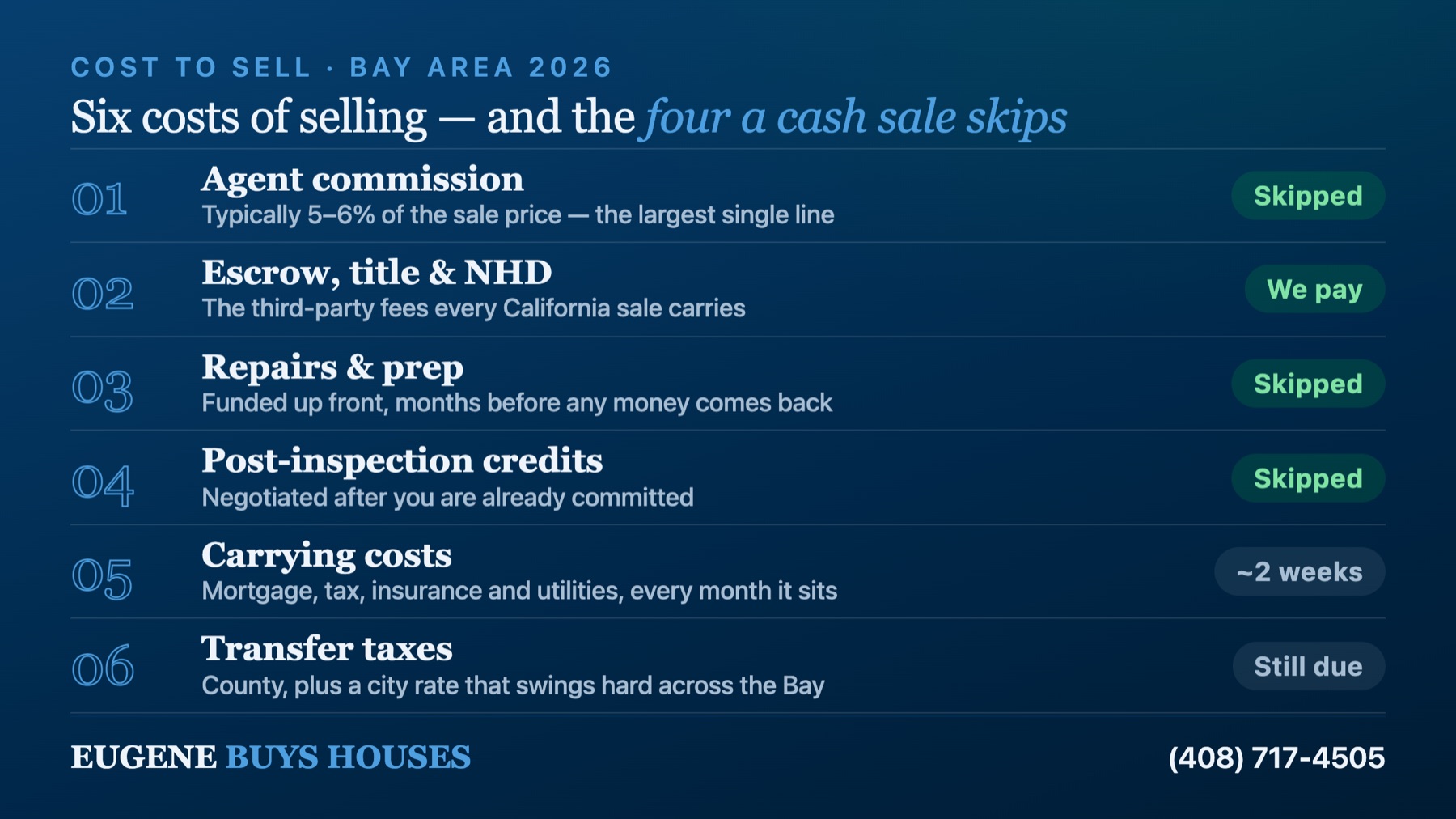
Most articles on this subject cover only the third of these, and most online calculators subtract only the first. Here is the whole list:
- Agent commission — the largest single line, and the one everyone knows about.
- Repairs and prep to list — paid up front, months before any money comes back.
- Seller closing costs — escrow, title, transfer taxes, disclosures, recording.
- Buyer credits after the inspection — negotiated once you are already committed.
- Carrying costs — every month the house is being prepped, listed and in escrow.
- The mortgage payoff — not a "cost", but it is what turns a sale price into proceeds.
1. Agent commission: 5-6% of the sale price
Still the biggest number on the page. On a $900,000 Bay Area home, 5.5% is $49,500.
Since the 2024 NAR settlement, sellers are no longer required to advertise buyer-agent compensation through the MLS, and the two sides are negotiated separately. In practice buyer-agent compensation has not vanished — it has moved into the negotiation, and buyers routinely ask sellers to cover it. Treat "commission is negotiable now" as true but smaller than it sounds. The FSBO version of this arithmetic, including what you actually save, is in selling a house without a realtor in California.
2. Repairs and prep: the cost that comes before the money
This is the line that does not appear on any closing statement and that sinks the most budgets, because you pay it in March and get paid in July.
- Deferred maintenance — roof, water heater, panel, dry rot, the fence that has been leaning for six years.
- Cosmetic work — paint inside and out, flooring, light fixtures, landscaping.
- Clear-out and haul-away — for a long-held or inherited house, this is frequently thousands on its own.
- Staging and photography — commonly a few thousand in this market.
- Pre-listing inspections — optional, and often worth it, because a report you commissioned is far easier to manage than one the buyer commissions.
On an ordinary older Bay Area house this range runs from a few thousand for a light refresh to $60,000-plus once anything structural is involved. If the number is large and you do not want to fund it, that is the case for selling as-is in California rather than borrowing to prepare a house you are leaving.
3. Seller closing costs — the line-by-line
Escrow fees: $2,000-$5,000
The escrow company holds funds and documents. In Northern California these are typically split between buyer and seller, though it is negotiable.
Title insurance: $1,500-$4,000
In California the seller traditionally pays for the buyer's owner's policy. The cost scales with the sale price.
Transfer taxes — where the Bay Area gets expensive
California charges a county documentary transfer tax of $1.10 per $1,000 of sale price, which is standard statewide. Then the city adds its own, and the spread between cities is the single most underestimated number in a Bay Area sale:
- San Francisco: graduated by price, starting around $6.80 per $1,000 and rising steeply on high-value sales
- Oakland: $15.00 per $1,000 on properties over $300,000
- Berkeley: $15.00 per $1,000
- Richmond: $7.00 per $1,000
- Hayward: $8.50 per $1,000 (raised from $4.50 by Measure T in November 2018)
- San Jose: $3.30 per $1,000
On a $900,000 sale that is $14,490 in Oakland ($990 county plus $13,500 city) against $3,960 in San Jose and $8,640 in Hayward. Same house, same price, a ten-thousand-dollar difference decided by a city line. Hayward is a good example of why you cannot rely on an old figure: the city doubled its rate at the 2018 election and plenty of calculators still quote the pre-2019 number. Rates change — confirm yours with escrow or your city before you rely on any of these figures.
Prorated property taxes
You owe taxes up to the day of closing. If you have prepaid through your lender's impound account you may receive a credit; if you are behind, the arrears come out of proceeds.
HOA transfer fees and documents: $200-$1,000
On a condo or townhouse, the association's transfer package and fees. Worth ordering early — the turnaround is a real dependency.
Natural Hazard Disclosure report: $100-$200
California requires an NHD report identifying flood, fire, earthquake-fault and other designated zones. Seller pays.
Home warranty (optional): $300-$600
Sometimes offered to the buyer as an incentive. Genuinely optional.
Notary and recording fees: $100-$300
Small and unavoidable.
Outstanding liens or judgments: varies
Property tax liens, mechanic's liens, judgment liens and HOA liens all have to clear from proceeds before you are paid. If that applies to you, start with selling a house with a tax lien in California — it is solvable at closing, but only if escrow knows in advance.
4. Buyer credits after the inspection
The most reliably forgotten line. Once you are in contract, the buyer's inspector produces a report, and what follows is a negotiation you enter from a weak position — the house is off the market, you have already mentally moved, and the alternative is starting again.
Bay Area credits commonly land in the $5,000-$15,000 range on an ordinary house and considerably more when the report finds something structural. Budget for it; being pleasantly surprised is better than the reverse.
5. Carrying costs — the clock nobody prices
Every month between deciding to sell and recording the deed, you are still paying:
- Mortgage principal and interest
- Property tax and insurance
- HOA dues
- Utilities — including on an empty house, because it still needs power, water and heat
- Landscaping and upkeep so it keeps showing well
For a typical Bay Area homeowner that runs into thousands a month, and the full calendar is longer than most people assume — we broke it down stage by stage in how long it takes to sell a house in the Bay Area. Prep, market time and escrow together commonly total two to four months, so this line is rarely small.
A real Bay Area example: $900,000 in Hayward
A 1,500 sq ft 1960s ranch, tidy but dated, expected to sell at $900,000 after a moderate refresh.
- Agent commission (5.5%): $49,500
- Repairs, paint, flooring, clear-out, staging: $28,000
- Escrow (seller's share): $2,500
- Title insurance: $2,800
- County transfer tax: $990
- Hayward city transfer tax ($8.50 per $1,000): $7,650
- NHD report: $150
- Notary and recording: $200
- Home warranty: $450
- Buyer credits after inspection: $9,000
- Carrying costs (3 months at $4,200): $12,600
- Total cost to sell: $113,840 — about 12.6% of the sale price
Note how far that sits from the "closing costs are 1-3% for sellers" figure you will find on national sites. They are quoting line item 3 in isolation. The cost of selling is all six.
What a cash sale actually skips — and what it doesn't
Here is the same house sold directly to a local cash buyer, as-is, closing in about two weeks.
Gone:
- Agent commission — $0. No agents on either side.
- Repairs and prep — $0. Sold as-is. Nothing painted, nothing cleared, nothing staged.
- Escrow, title, NHD, home warranty — $0. We pay the standard seller closing costs.
- Buyer credits — $0. The condition is priced into the offer rather than renegotiated after an inspection.
Still yours:
- Transfer taxes. County and city. These are government charges and no buyer makes them disappear — be skeptical of anyone who says otherwise.
- Prorated property taxes up to the closing date.
- Any liens recorded against the property, cleared from proceeds at closing.
- About two weeks of carrying costs instead of three months.
On the Hayward example, that is roughly $103,000 of the $113,840 avoided — and the honest counterweight is that the cash offer itself is below the $900,000 open-market figure, because the buyer is absorbing the repairs, the resale risk and the holding period. The full arithmetic of how far below, with worked numbers, is in how much cash home buyers actually pay.
Which means the only comparison that matters is net against net, not price against price. A listing at $900,000 that nets $786,160 before the mortgage payoff, against a cash offer that nets nearly all of itself. Sometimes the listing still wins — usually when the house shows well and needs little work. Sometimes it does not. Our full cash-offer-versus-listing comparison works through both cases, and the proceeds calculator will do it on your own figures in about a minute.
How to reduce what it costs you
- Negotiate the listing side of the commission. It is genuinely negotiable, and on Bay Area prices half a point is real money.
- Don't over-improve. Buyers pay for kitchens and bathrooms; they rarely pay back a new fence or a landscaped side yard.
- Get a pre-listing inspection. A report you commissioned puts you in a far better position than one sprung on you at day 12.
- Check your city's transfer tax before you price. Especially in Oakland, Berkeley or San Francisco, where it is a five-figure line.
- Shorten the calendar. Carrying costs are the one line that grows purely with time, and the only lever on it is speed.
- Price it right the first time. A price cut after four weeks costs more than the cut — it costs another month of everything above.
Questions Bay Area sellers ask about the cost of selling
How much does it cost to sell a house in California?
Counting everything — commission, repairs and prep, seller closing costs, buyer credits and carrying costs — commonly 9% to 14% of the sale price. Closing costs narrowly defined are a much smaller slice, roughly 1% to 3%, which is why national figures look so much lower than the check you actually walk away with.
What closing costs does a seller pay in California?
Escrow fees (usually split), the buyer's title insurance policy, county transfer tax of $1.10 per $1,000 plus any city transfer tax, prorated property taxes, HOA transfer fees, the natural hazard disclosure report, notary and recording, and any liens clearing from proceeds.
Who pays transfer tax in California, the buyer or the seller?
By custom the seller pays, but it is negotiable and the convention varies by county and city. Some cities split it. Confirm with escrow before you assume.
Is the realtor commission in California fixed?
No. It has always been negotiable, and since the 2024 NAR settlement each side is negotiated separately. Expect the listing side to be the part you can actually move.
Do I pay closing costs if I sell to a cash buyer?
With us, no — we cover the standard seller closing costs. Transfer taxes and prorated property taxes still apply, because they are government charges, and any liens still clear from proceeds. Anyone claiming to eliminate transfer tax is telling you something untrue.
How do I work out my net proceeds?
Sale price, minus all six categories above, minus the mortgage payoff. Our home sale proceeds calculator does exactly that and puts a cash-sale column next to it.
Are selling costs tax-deductible?
Selling costs generally reduce the amount realized on the sale, which reduces your taxable gain — that, together with the home-sale exclusion, is why most sellers owe little or no capital gains tax. The detail is in capital gains tax when selling a house in California, and it is a question for your CPA rather than for us.
Get the number that skips most of this
You now have the full cost of selling the conventional way. The useful next step is the other number to hold it against.
Call (408) 717-4505 for a free, no-obligation cash offer on your Bay Area house, with the repair math shown and proof of funds attached — no commission, no repairs, no credits, and we pay the closing costs. And if your house shows well and listing would genuinely net you more after all of the above, we will run that comparison with you and tell you so.


