
"We Buy Ugly Houses" is the most recognized phrase in this entire business, and the brand behind it — HomeVestors — has been buying houses since 1996. If you are reading this, you have probably had the postcard, seen the billboard, or already taken the call, and you are trying to work out one thing: is the number they gave me any good?
Read the search results for that phrase and you will notice something. Above the fold is the company's own site. Everywhere below it are Reddit threads, Yelp pages, a ListWithClever piece titled "here's what they offered," and a 2023 ProPublica investigation called "The Ugly Truth Behind 'We Buy Ugly Houses.'" Google has already decided this is a trust query, not a sales one. So this page is written to answer the trust question honestly.
Where we stand: we are Eugene Bay Area Home Buyers, a local Bay Area cash buyer based in San Jose. We are a competitor of the franchise, so weigh everything here accordingly — and then check it, using the checks at the bottom, which work on us exactly as well as they work on them.
First, the plain facts about the brand
"We Buy Ugly Houses" is the consumer-facing trade name of HomeVestors of America. The cartoon caveman, the billboards and the postcards all belong to the national franchisor. The person who walks your house does not.
HomeVestors sells franchises. A local investor buys a territory, pays an up-front franchise fee, pays an ongoing royalty on purchases, contributes to the national advertising fund, and gets the brand, the lead flow, the training, the valuation software and access to franchise lending. When you call the number on the postcard, the lead is routed to whoever owns your zip code.
That structure is not a scandal — it is how Ace Hardware and most of your local fast food works. But it has two consequences for your sale, and they are the whole story:
- The brand is national; your buyer is one local businessperson. The person quoting your house has their own capital, their own repair crew, their own appetite for risk, and their own standards of conduct. The national brand sets the script. It does not sit at your kitchen table.
- Every one of those franchise costs has to come out of somewhere — and the only place it can come from is the gap between what they pay you and what the house is worth fixed up.
How a franchise offer is actually calculated
Franchise pricing runs on the same basic arithmetic every cash buyer uses. Start with after-repair value — what the house sells for once it is renovated. Subtract the repair budget. Subtract the buyer's required margin. What's left is your offer.
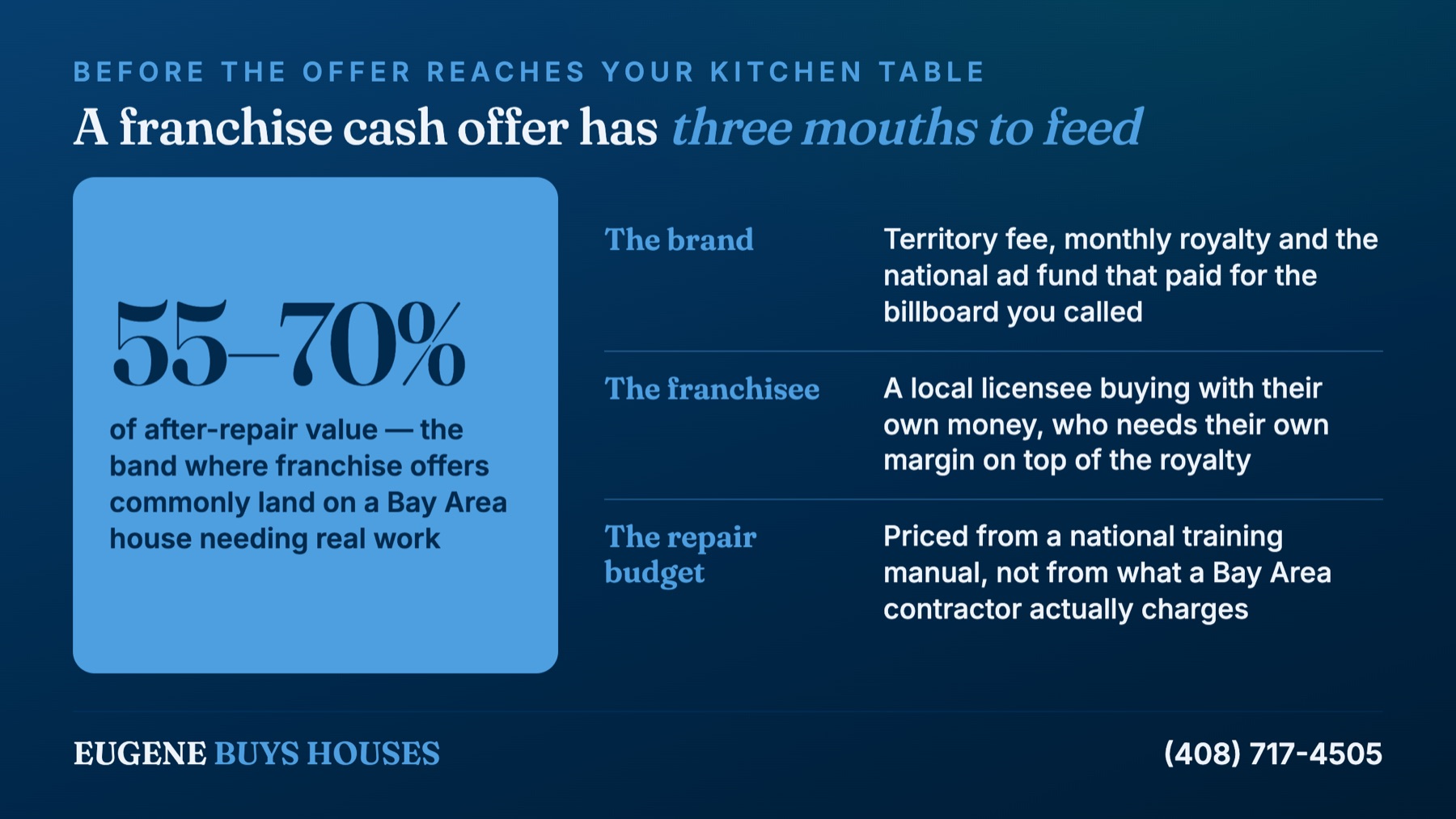
The difference is what sits inside "required margin." A franchisee's margin has to cover their own profit and the royalty, the ad fund and the cost of the territory. That is why franchise offers on houses needing genuine work commonly land in the 55-70% of after-repair value band, while a direct local buyer with no royalty stack is typically working nearer the top of that range or above it. We publish our own version of this arithmetic, with real numbers, in our guide to what cash home buyers actually pay — read it alongside whatever the franchise quotes you, because the two are directly comparable.
A worked Bay Area example
Take a 1958 ranch in San Jose, worth $950,000 renovated, needing about $90,000 of real work — roof, panel, kitchen, one bathroom, and a garage conversion that was never permitted.
- Franchise offer: roughly $520,000-$665,000, depending on the franchisee's cost of capital and how conservatively their manual prices that garage.
- Direct local buyer: after-repair value minus real repairs minus margin, with no royalty in the middle — on these numbers, generally the $700,000s.
- Listed as-is on the open market: potentially more than either, minus commission, minus closing costs, minus two to four months of carrying costs, minus whatever the buyer's inspector negotiates back.
Those are ranges, not promises, and the honest headline is that no cash buyer pays retail. Every model on this page funds speed, certainty and repair risk out of the spread. The question is never "is there a discount" — there always is. The question is how large it is, and how many parties are taking a cut of it.
Why the Bay Area breaks the national manual
A franchise system's biggest advantage is repeatability: the same training, the same software, the same repair cost tables nationwide. That advantage becomes a liability here, because our housing stock is unusually old, unusually expensive, and unusually non-standard.
- Repair costs. A full rewire, a foundation lift or a sewer lateral in Oakland does not cost what the national table says. A manual built on averages either overprices the repair — which lowers your offer — or underprices it, and the franchisee walks after the inspection.
- Permit history. Converted garages, added bathrooms and 1980s additions done without permits are everywhere in the East Bay and the Peninsula. A national valuation model tends to treat unpermitted square footage as a risk deduction. A buyer who has legalized three of them in your city prices it as a known cost.
- Price bands. A model calibrated on $180,000 houses in Texas behaves differently on a $900,000 house where a five-percent pricing error is $45,000 of your money.
- Local rules. City transfer taxes, point-of-sale inspection and sewer-lateral requirements, rent-control and just-cause rules on a tenant-occupied property — all of it is city-by-city here, and none of it appears on a national postcard.
This is not an argument that the franchise cannot buy your house. It buys plenty of them. It is an argument for reading their number as one bid from one pricing model, and getting at least one more from someone whose repair costs come from this county.
About the ProPublica investigation
If you have been researching, you have hit it: in 2023 ProPublica published an investigation into HomeVestors franchisees' conduct, reporting cases in which sellers — often elderly, ill, or in serious financial distress — said they were pressured into contracts, and describing the use of contract devices that tied up homes. HomeVestors publicly disputed parts of the reporting, said the conduct described did not reflect its standards, and stated it had terminated franchisees and tightened its policies in response.
The fair way to read that, as a seller, is this: the reporting was about the behavior of individual franchisees, not about whether cash sales work. No national brand, ours included, can put a character reference behind the specific human being who rings your doorbell. Which is exactly why the only reliable protection is the paperwork — and the paperwork checks below are ones any legitimate buyer will hand over without hesitating. We cover the full version in how to tell whether a Bay Area cash home buyer is legitimate.
Franchise, iBuyer, wholesaler, local buyer — where the franchise sits
There are only four kinds of company that will ever offer on your house, and we broke all four down in our guide to Bay Area home-buying companies. Briefly, against the franchise:
- iBuyers (Opendoor, Offerpad). Closest to market on a clean, conventional, newer house — then a service fee and post-inspection deductions come off. They decline most of the houses a franchise targets. Full fee arithmetic in our Opendoor and Offerpad comparison, and what sellers report afterwards in Opendoor reviews from Bay Area sellers.
- Wholesalers. Not buyers at all — they tie your house up and sell the contract on. They are the type most likely to open high and revise later, and the type most often mistaken for a franchise or a local buyer. The tells are in cash buyer vs wholesaler in California.
- Local cash buyers. Our model: our own funds, our own crews, no royalty, no assignment. Our disadvantage against the franchise is that we have no national brand to reassure you with, so we have to earn it with documents instead.
- The franchise. A real buyer with real money and a decades-old name, carrying an extra cost layer and a pricing model built for the national average.
If you are going to call them — do these five things first
- Get a second and third number. One offer is not a market. An afternoon of calls prices every option you have, and it costs nothing. Nobody legitimate objects to you shopping.
- Ask for the repair estimate in writing, line by line. The offer is a subtraction. If you cannot see what is being subtracted, you cannot tell a hard-nosed bid from a fishing expedition.
- Ask who takes title. "Will the entity on this contract be the entity on the deed?" Then read the contract for an assignment clause. A franchisee buys in their own entity — confirm it.
- Ask for proof of funds, dated this month, in that entity's name. Before you sign, not after.
- Refuse to sign on the first visit. There is no legitimate reason for an offer to expire tonight. Any pressure to sign at the kitchen table tells you more about the buyer than the price does.
And if the house needs enough work that this is the conversation you are having at all, read selling a house as-is in California before you agree to any repairs for anyone — you are almost certainly not obliged to do them.
Questions Bay Area sellers ask about We Buy Ugly Houses
Is We Buy Ugly Houses legit?
HomeVestors is a real company that has been operating since 1996 and its franchisees close real purchases every week. The legitimate concern is not the corporate entity — it is that your experience is delivered by an independently owned local franchise whose conduct the brand supervises but does not perform. Vet the person, not the logo.
How much does We Buy Ugly Houses pay?
There is no published formula, but the model is after-repair value minus repairs minus margin, with the franchise royalty and ad fund inside that margin. On houses needing significant work, offers commonly fall in the 55-70% of after-repair value range. They do not pay market value, and they do not claim to.
Is HomeVestors the same company as We Buy Ugly Houses?
Yes. "We Buy Ugly Houses" is HomeVestors' consumer-facing brand. The local operator you actually deal with is an independently owned franchise.
Do they charge fees or commission?
Typically no commission and no service fee — that is a genuine advantage of the franchise model over an iBuyer, where the fee comes off the headline. The cost is inside the offer price instead, which is harder to see. Compare net-of-everything, not fee-by-fee.
Can you negotiate a franchise offer?
Sometimes, and the lever that works is evidence: a competing written offer, a contractor's bid that contradicts their repair estimate, or a comparable sale they missed. Arguing about the number without evidence rarely moves it.
Will they lower the offer after the inspection?
They can, and this is the single most important question to ask at the kitchen table: "Is this number final, or is it subject to revision after inspection?" Get the answer in writing. A revision-after-inspection clause is not automatically bad faith — but it turns the number you were quoted into an opening position, and you should treat it as one.
What if my house isn't ugly?
Then a franchise is probably the wrong door. Their whole model is deep-discount purchases of properties needing work. A tidy, conventional house is better served by an iBuyer quote or a normal listing, and any honest buyer will tell you so.
The local version of the same offer
We buy the same kind of house the franchise advertises for — dated, damaged, tenant-occupied, inherited, half-finished, or simply too much to deal with right now — across Hayward, Oakland, San Jose and 66 other Bay Area cities. The differences are that there is no royalty inside our number, the repair estimate comes from crews working in your city this month, and the person who prices your house is the person whose money buys it.
Get the franchise's number. Then call (408) 717-4505 and get ours, with the repair math shown and proof of funds attached, so you have something real to hold it up against. It is free, there is no obligation, and if listing the house would genuinely net you more, we will show you that arithmetic and tell you to list it.


