Search "home buying companies" and you get two things: national listicles ranking Opendoor against HomeVestors, written by people who have never bought a house in California, and ads from companies that may or may not exist next month. What you actually need is simpler and nobody writes it down: there are only four kinds of company that will offer on your house, they pay very differently, and each one is genuinely the right answer for a different seller.
We are one of the four — a local cash buyer based in San Jose — so read this knowing where we sit. But the honest version of this guide is the whole point: two of our competitors' models are the better choice for some sellers, and we will tell you which sellers those are. What we won't do is pretend the four types are interchangeable, because the gap between the best and worst outcome here is the largest avoidable mistake in a cash sale.
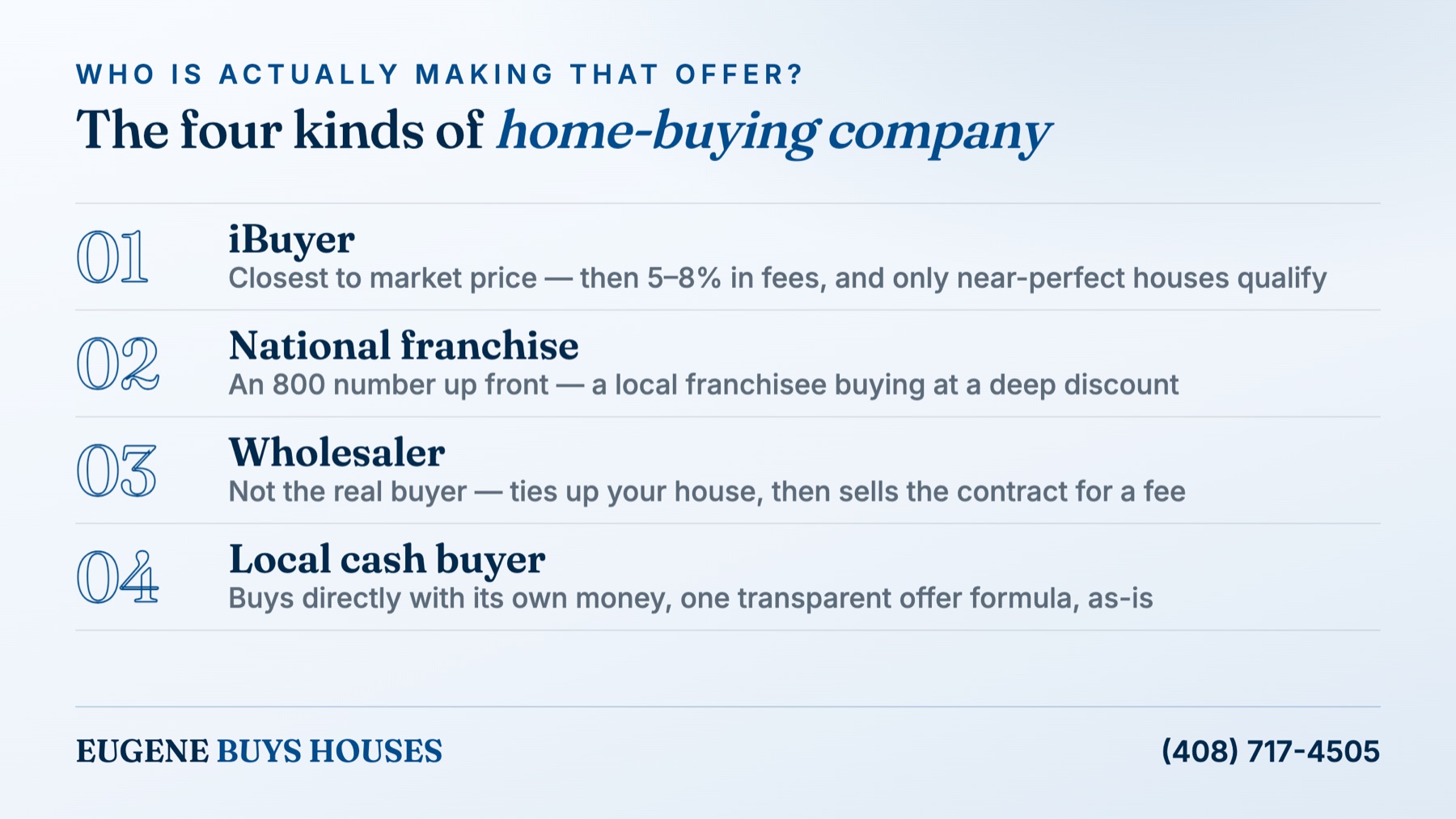
The four kinds of home-buying company
Every "we buy houses" sign, every instant-offer website, every letter in your mailbox comes from one of these four models. Before you request a single offer, work out which one you are talking to — everything downstream (the price, the timeline, whether the deal actually closes) follows from the model, not from the company's marketing.
Type 1 — iBuyers: the algorithm with a fee schedule
Who they are: Opendoor is the one still standing at scale; Offerpad operates in some markets, and Zillow and Redfin both launched and shut down their versions. Venture-funded technology companies that price homes with an algorithm, buy them lightly, resell them quickly.
How it works: you enter your address, the model produces a preliminary number, an inspector walks the house, and the final offer arrives with a service fee — historically around 5%, plus deductions for whatever the inspection found. Close on your schedule, often inside two weeks.
What they really pay: the headline offer is genuinely the closest to market value of the four types — that is the model's selling point. The arithmetic that matters happens after: service fee, repair deductions decided by their inspector on their numbers, and seller closing costs still yours. Sellers routinely net 8-12% below what the headline suggested. We walked through the full arithmetic, with the fee schedules, in our Opendoor and Offerpad comparison — and the patterns sellers describe afterwards in Opendoor reviews from Bay Area sellers.
The catch in the Bay Area: the buy-box. iBuyer algorithms want post-1960s construction, standard floor plans, no major systems work, no foundation questions, no unpermitted additions — and they have retreated from much of the Bay Area's priciest and oldest stock precisely because our houses fail those filters. A 1952 San Jose ranch with a converted garage doesn't get a lowball from an iBuyer; it usually gets no offer at all.
Right answer for: a newer, clean, conventional house whose owner values convenience over the last few percent and simply doesn't want showings. That is a real seller, and for them the iBuyer is legitimately hard to beat.
Type 2 — National franchises: an 800 number and a local licensee
Who they are: HomeVestors ("We Buy Ugly Houses") is the giant; Express Homebuyers and a rotating cast of others use the same structure. The brand is national; the buyer is a local franchisee who paid for the territory and the phone number.
How it works: the call centre routes you to whoever holds your zip code. The franchisee visits, quotes, and buys with their own or borrowed money, following the franchise's pricing training — which is built on buying at a deep discount to after-repair value. The model has bought houses for decades and does close.
What they really pay: the franchise economics stack a royalty and the franchisee's own margin on top of the repair budget, which is why offers commonly land around 55-70% of after-repair value on houses needing real work. The quality of your experience is also entirely the local franchisee's — the national brand sets the script, not the standard. We took this model apart in detail, including the 2023 ProPublica reporting, in what a We Buy Ugly Houses franchise offer really looks like in the Bay Area.
Right answer for: genuinely distressed properties in markets with no strong local buyer — and sellers who value a decades-old brand name over price and want the process fully scripted.
Type 3 — Wholesalers: the offer from someone who isn't buying
Who they are: the hardest type to identify, because they work hardest to look like type 4. A wholesaler is an individual or small outfit that gets your house under contract and then sells that contract — not the house, the contract — to an actual investor, keeping the difference as an assignment fee.
How it works when it works: you sign at an agreed price, the wholesaler shops the contract to their buyer list, an end buyer closes, and the wholesaler collects $10,000-$50,000 of what could have been your money. How it works when it doesn't: no end buyer materialises at the right price, and the wholesaler exits through an inspection contingency — five weeks after you stopped answering other buyers.
What they really pay: whatever number gets your signature, which is precisely the problem. The offer is a placeholder for a resale that hasn't happened yet, which is why wholesaler offers frequently open high and then "adjust" once a real buyer prices the deal. The tell-tale signs — assignment clauses, vague proof of funds, long inspection periods — are catalogued in our guide to telling a cash buyer from a wholesaler.
Right answer for: honestly, almost no Bay Area seller. In markets with few real cash buyers a good wholesaler provides access. Here, the investors on their buyer list will buy from you directly — the wholesaler is an added fee, not added access.
Type 4 — Local cash buyers: the direct model
Who they are: companies based in the market they buy in, purchasing with their own funds, renovating and reselling or holding. This is our model, so apply the appropriate discount to everything in this section — and then verify it the same way you should verify anyone, which we cover below.
How it works: you deal with the decision-maker. The person who walks your house is the person whose money buys it. There is no algorithmic buy-box, no franchise royalty in the middle, and no assignment — the name on the contract is the name on the deed transfer. The offer comes from one piece of arithmetic: after-repair value, minus the real repair cost, minus the buyer's margin. We publish ours, worked through with real numbers, in how much cash home buyers actually pay.
What they really pay: typically between the iBuyer and the franchise — below an iBuyer on a clean conventional house (where the iBuyer's thin-margin model wins), and meaningfully above a franchise on a complicated one, because there is no royalty stack and a local buyer prices Bay Area repair costs from experience rather than a national manual. On the houses iBuyers won't touch — older stock, deferred maintenance, tenants, probate, fire and water history — the local buyer is usually the only real offer left standing.
The catch: "local cash buyer" is also what every wholesaler claims to be, and there is no franchise brand or public company behind the claim. The vetting section below is how you tell — and any legitimate local buyer will pass it without flinching.
Right answer for: houses with a story — condition, timeline, legal complexity — and sellers who want a real number from a real person who has seen the house, rather than a formula's opening bid.
What each type actually pays — the honest comparison
Take a house worth $900,000 fixed up, needing $80,000 of real work. Roughly, and honestly:
- iBuyer: likely declines it at $80K of repairs. If the work were cosmetic instead, expect a headline near market with 8-12% coming off in fees, deductions and closing costs — the strongest net of the four when the house qualifies. What that feels like from the seller's side is catalogued in Opendoor reviews from Bay Area sellers.
- National franchise: somewhere around $500,000-$630,000, depending on the franchisee's appetite and the royalty math.
- Wholesaler: possibly the highest opening number in the pile — revised downward once an end buyer actually prices it, or abandoned. The offer is marketing until their buyer exists.
- Local cash buyer: after-repair value minus repairs minus margin — on these numbers, an offer in the $680,000-$740,000 range from a buyer pricing the $80,000 honestly, with no fee subtracted afterwards and no contract to resell. Whether that beats listing as-is on the open market is a genuine question, and the answer is "it depends on condition and your timeline" — we wrote the unvarnished version in the offer-math guide.
Notice what actually separates the four: not the headline number, but how far the headline is from the wire transfer. iBuyers subtract after the offer. Wholesalers revise after the signature. Franchises open low but generally close there. A direct buyer's offer should be the closing number — which is exactly what a real cash offer looks like on paper: proof of funds attached, no financing contingency, a named closing date, and no assignment clause.
Which one fits your situation
- Newer house, good condition, you want zero hassle: get the iBuyer quote first. Compare its net — after fee and deductions — against a direct buyer's flat number and a conventional listing before you sign anything.
- House needs real work, or has a story: tenants, probate, code violations, fire or water history, hoarding, unpermitted space — the iBuyer is out, and this is where selling as-is to a direct local buyer earns its keep. Get more than one number anyway.
- Facing a hard deadline: foreclosure date, relocation, estate settlement — speed and certainty outrank the last dollar. That means proof of funds, a short escrow and no contingencies, from whichever buyer can document all three. Our guide to selling a Bay Area house fast ranks the options by real elapsed days.
- No rush, house shows well: then honestly, list it. Every model on this page trades money for speed and certainty; if you need neither, the open market pays more, and any home-buying company that tells you otherwise is selling.
How to vet any of them — five checks, two minutes each
The four types converge on one doorstep test. Whoever is sitting across your kitchen table:
- Proof of funds, before you sign. A bank statement or escrow-ready letter, dated this month, in the buying entity's name. iBuyers and franchises produce this instantly; a genuine local buyer within the hour; a wholesaler changes the subject.
- Who takes title? Ask directly: "Will the entity on this contract be the entity on the deed?" A pause is an answer. So is an assignment clause.
- Verifiable local footprint. Closed purchases in county records, an address, reviews attached to real transactions. The full checklist — licence lookups, record searches, the works — is in our guide to vetting Bay Area cash buyers.
- A number that survives the walkthrough. Any model may adjust after inspection; the question is by how much and from what evidence. Ask for the repair line items. A buyer pricing honestly shows you; a buyer fishing shows you a lower number.
- Comfort with your lawyer reading it. Escrow at a real title company, a contingency period measured in days not months, and no pressure to sign tonight. Anyone rushing your signature is telling you what the paper says.
The Bay Area wrinkle: our houses break the national models
The reason national rankings of home-buying companies mislead Bay Area sellers is simple: the region's housing stock is old, expensive and non-standard, which is poison to models built on national averages. A 1948 Oakland bungalow with knob-and-tube wiring, a San Jose Eichler with a radiant slab, a Fremont ranch with a garage conversion done in 1989 without permits — the iBuyer's algorithm declines all three, the franchise manual prices their repairs from a spreadsheet built in Texas, and the wholesaler ties them up hoping someone local knows what they're worth. The buyer left standing is the one who has repaired that exact wiring, that exact slab, in this exact market — which is why the local model persists here despite having no national ad budget.
Questions sellers ask us about home-buying companies
Are home-buying companies legitimate at all?
The four models are all legal and all close real purchases every week. Legitimacy problems live at the level of the individual operator — which is why the vetting checks above matter more than the brand name, and why "is this company legit" is a question about documents, not logos.
Why did three different companies quote me wildly different numbers?
Because you likely spoke to three different models. An iBuyer minus fees, a franchisee minus royalty and margin, and a wholesaler guessing at a resale are pricing three different businesses, not disagreeing about your house. Line the offers up net-of-everything, with each buyer's repair estimate in writing, and the spread usually explains itself.
Do any of them pay full market value?
No — and treat anyone claiming to as failing check four. Every model here funds its speed, certainty and repair risk out of the spread between its price and retail. The honest framing is that you are selling three things: the house, the repair risk, and the timeline. The open market pays most for the house; these companies pay for taking the other two off you.
Should I get offers from more than one type?
Yes, and in this order: an iBuyer quote if your house might qualify (it's free and fast), then one or two direct local buyers, then — with those numbers in hand — a listing agent's honest as-is estimate. An afternoon of calls prices all your options. Skip the wholesaler tier entirely; nothing they offer exists until someone from the other tiers shows up anyway.
Get the local number, straight
We are the fourth type: Eugene Bay Area Home Buyers, based in San Jose, buying directly with our own funds since before instant offers existed. If you want the number a local buyer actually pays — with proof of funds attached, the repair math shown, and a plain "list it instead" if that is truthfully your better path — call (408) 717-4505. The offer is free, there is no obligation, and you will know which kind of company you are talking to, because we just told you how to check.