You own a property with someone else — inherited it with siblings, bought it with a partner, or ended up on the deed with a family member — and now you want to sell, but the other owner won't. You've started reading about a partition action in California, the legal process that can force the sale of a co-owned property. Almost every result you'll find is a law firm explaining how to file one.
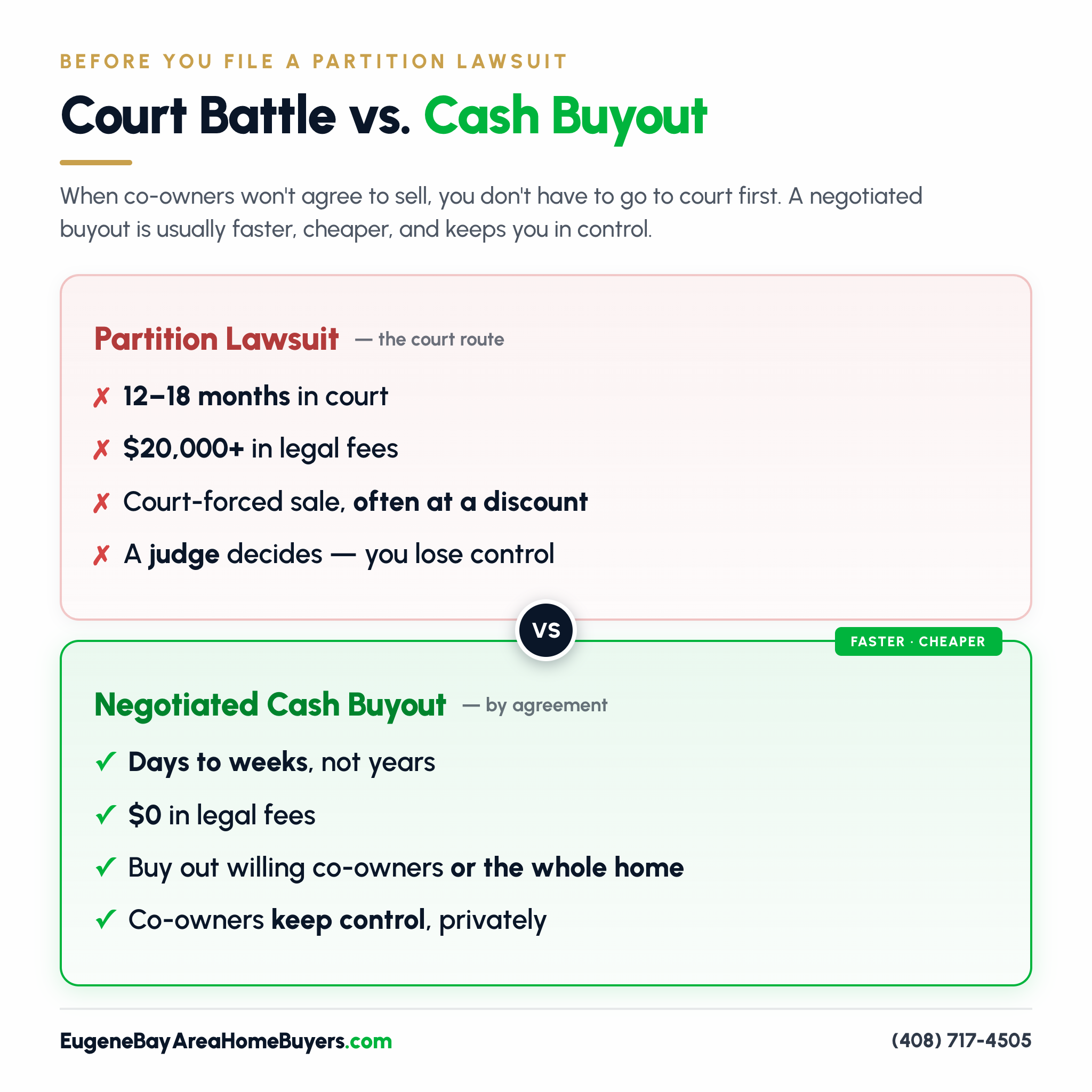
Here's what those pages don't tell you: a partition lawsuit is the last resort, not the first move. It works, but it takes 12–18 months, costs $20,000 or more in legal fees, and ends in a court-forced sale that often nets everyone less. Before you file, there's usually a faster and cheaper off-ramp — a negotiated cash buyout, where a buyer purchases the willing co-owners' shares (or the whole property by agreement) in days to weeks, with no court and no legal bills. This guide explains how partition actions actually work in California, and when the buyout path is the smarter move. (One note up front: this is general information, not legal advice — talk to a real-estate or probate attorney about your specific situation.)
What a partition action actually is
A partition action is a lawsuit that asks a California court to divide or sell a jointly owned property when the co-owners can't agree on what to do with it. Any co-owner — no matter how small their share — has the legal right to file one. There are two possible outcomes the court can order:
- Partition by sale. The court orders the property sold and the proceeds divided among the owners according to their ownership shares. This is by far the most common outcome for a single home, since you can't physically split a house.
- Partition in kind. The court physically divides the land among the owners. This only works for large or raw parcels that can actually be split — almost never for a single-family home.
In other words, a partition action is the legal hammer that guarantees a co-owner can eventually get out of a shared property, even if the others refuse. It's a real and powerful right. It's also slow, expensive, and adversarial — which is why it should be the option you keep in your back pocket, not the one you reach for first.
The problem: partition lawsuits are slow, costly, and out of your control
Filing a partition action means handing the outcome to the court system. That comes with real downsides:
- Time: 12–18 months, often longer. Between filing, service, the appointment of a referee to oversee the sale, and the sale process itself, a contested partition routinely runs a year and a half. If any owner fights it, longer.
- Cost: $20,000+ in legal and court fees. Attorney's fees, the referee's fees, and court costs come out of the sale proceeds — reducing what everyone walks away with. In a contested case the legal bill climbs fast.
- A court-forced sale often nets less. A partition sale (sometimes by public auction) rarely achieves top market value the way a normal, well-marketed sale can — so even the "winner" of the lawsuit can end up with less money.
- You lose control. Once it's in front of a judge, the timeline, the sale method, and the price are out of your hands. So is the relationship — a partition suit against a sibling or family member usually ends whatever was left of it.
The graphic below shows the two paths side by side.
The off-ramp most people miss: a negotiated cash buyout
Here's the move that rarely shows up in the law-firm articles: before anyone files, a cash buyer can often resolve the deadlock by buying out the willing co-owners — or purchasing the whole property by agreement — without a lawsuit at all. It works a couple of ways:
- Buy the willing owners' shares. If you want out and a co-owner wants to keep the home, a cash buyer can purchase your share (or the co-owner can), so you get your equity now and they keep the property. No one is forced out.
- Buy the whole property with everyone's sign-off. If the owners are mostly aligned that selling is the right call — they just dread the drawn-out, contentious process — a direct cash sale closes it quickly, splits the proceeds cleanly at closing, and skips the market prep, showings, and months of holding costs.
- Use the threat of partition as leverage, not the lawsuit itself. Often, once a reluctant co-owner understands that a partition action will eventually force a sale — just slower and with $20k+ in fees eating everyone's share — they become far more willing to agree to a clean buyout instead. A cash offer on the table turns an abstract standoff into a concrete choice.
Because we pay cash and buy as-is, we can move in days to weeks, coordinate with everyone's attorneys, and close through a neutral escrow that pays each owner their share. It's the same clean, private resolution a partition sale is supposed to produce — without the year in court or the five-figure legal bill. If you want to understand how the offer itself is built, see how much cash home buyers pay.
The California heirs' property rule that helps you (2022)
If you inherited the property, there's a law worth knowing: the Uniform Partition of Heirs Property Act, which California adopted effective 2022. When a partition involves inherited "heirs property," it gives the co-owners who don't want to sell the first right to buy out the share of the co-owner who filed, at a court-determined fair market value, before any forced sale happens. It also requires that if a sale does occur, it be an open-market sale (not a lowball auction) whenever possible.
In practice, this rule pushes inherited-property disputes toward exactly the buyout resolution described above — so it's often cleaner and faster to negotiate that buyout directly, with a cash buyer funding it, than to run the full court process to reach the same place. This is squarely attorney territory, so get legal advice, but know the law is designed to favor a buyout over a fire-sale.
Common situations where this comes up
Co-ownership deadlocks usually trace back to one of a few situations, and each has a cleaner path than a lawsuit:
- Inherited a house with siblings. One wants to sell, one wants to keep it, one wants to rent it out. This is the classic partition trigger — and usually the easiest to resolve with a buyout. Our guide on selling an inherited house with multiple owners walks through the options in detail.
- Divorce. Co-owning spouses who can't agree on the marital home can head toward partition, but a neutral cash sale usually resolves it faster and more fairly — see selling a house during a California divorce.
- The property is still in probate. If ownership hasn't fully transferred yet, the path runs through the estate — see selling a house in probate, or selling after death without probate when the home passed by trust or joint tenancy.
- Unmarried co-owners or investment partners. Friends, partners, or relatives who bought together and now disagree have the same options — buy each other out, or sell the whole thing by agreement.
When is a partition action actually the right call?
Sometimes the lawsuit genuinely is the answer. A partition action makes sense when a co-owner is truly unreachable, completely refuses every reasonable buyout offer, or is acting in bad faith — and you've exhausted the negotiated routes. In those cases the right to partition is exactly what protects you: it guarantees you can eventually get your equity out even against a fully uncooperative co-owner. The point isn't that partition is bad — it's that it should be the last tool you use, after a buyout has been offered and refused, not the first thing you file.
Frequently asked questions
Can I force the sale of a house if the other owner refuses?
Yes. In California, any co-owner can file a partition action, and the court can order the property sold and the proceeds divided — even if the other owner objects. But it takes 12–18 months and $20,000+ in fees, so it's usually worth trying a negotiated buyout first, where a cash buyer purchases the willing owners' shares or the whole property by agreement in a fraction of the time.
How long does a partition action take in California?
A contested partition typically runs 12–18 months from filing to completed sale, and longer if an owner actively fights it. A negotiated cash buyout, by contrast, can close in days to weeks because there's no court process involved.
How much does a partition action cost?
Commonly $20,000 or more once you add attorney's fees, the court-appointed referee's fees, and court costs — all of which come out of the sale proceeds and reduce what every owner receives. A contested case costs more. A direct buyout avoids these legal fees entirely.
Can I sell just my share of the property?
Yes. You can sell your ownership interest without the other owners' permission, and a cash buyer can purchase your share so you get your equity now while a co-owner keeps the home. This is often the cleanest resolution when one owner wants out and another wants to stay.
What is the Uniform Partition of Heirs Property Act?
It's a California law (effective 2022) that protects co-owners of inherited property. In a partition involving heirs' property, the owners who don't want to sell get the first right to buy out the filing owner's share at a court-determined fair value, and any sale must generally be an open-market sale rather than a discounted auction. It's designed to favor a fair buyout over a fire-sale.
Can you buy a house that's tied up in a co-ownership dispute?
Often, yes. We regularly buy homes where co-owners disagree — by purchasing the willing owners' shares, or the whole property once everyone agrees to sell. We pay cash, close through a neutral escrow that pays each owner their share, and coordinate with everyone's attorneys, which usually resolves the standoff far faster and cheaper than a partition lawsuit.
Will a partition sale get us full market value?
Not usually. A court-ordered partition sale — sometimes by auction — tends to net less than a normal, well-marketed sale, and the legal and referee fees come out of the proceeds on top of that. That's a big reason a negotiated sale or buyout, before filing, often leaves everyone with more.
The honest bottom line
A partition action is a real and powerful right — it guarantees you can eventually force the sale of a co-owned California property even if the other owner refuses. But it's slow (12–18 months), expensive ($20,000+), and hands control to a judge, often netting everyone less. Before you file, the smarter first move is almost always a negotiated cash buyout: buy out the willing co-owners, or sell the whole property by agreement, in days to weeks with no legal bills and everyone's share paid cleanly at closing. Keep the lawsuit as your last resort, not your opening move.
If you're stuck in a co-ownership standoff on a Bay Area property, tell us the situation and we'll walk you through your real options — including a fair cash offer for your share or the whole home — with no obligation. We buy as-is, close in as little as two weeks, and coordinate directly with your attorney or the estate. Call (408) 717-4505 for a free, confidential conversation. We buy across the Bay Area, including Oakland, San Jose, Hayward, and Richmond — and please confirm the legal specifics with a qualified attorney before you act.