
When someone passes away and leaves a house behind, the family's first fear is usually the same: probate — California's court-supervised process for settling an estate, which routinely takes 9 to 18 months and costs tens of thousands in statutory fees. The good news most people don't know: a large share of California homes can be sold WITHOUT full probate, and even the ones that can't be can still be sold while probate is open.
Here's the honest 2026 guide. Whether you can skip probate depends almost entirely on how the deceased held title and what was set up before they died. Let's find out which path applies to you.
First: Does the Property Actually Need Probate?
Before assuming you're stuck, check how the deceased held the property. Several common arrangements pass a home directly to heirs outside of probate entirely:
- Held in a living trust? If the home was titled in the name of a revocable living trust, it does NOT go through probate. The successor trustee can sell it directly. This is the cleanest path and the most common among Bay Area families who did estate planning.
- A recorded Transfer-on-Death (TOD) deed? California allows a revocable TOD deed that names a beneficiary who automatically receives the property at death — no probate. Check the county recorder's office for a recorded TOD deed.
- Joint tenancy or community property with right of survivorship? If the deceased co-owned the home this way (very common between spouses), the surviving co-owner already owns it outright. A simple affidavit of death + death certificate clears title — no probate.
- Small estate under the threshold? If the total estate value is below California's small-estate limit (roughly $184,500 as of 2026 — the figure is adjusted every three years for inflation, so verify the current number), you may be able to use a small-estate affidavit instead of probate after a 40-day waiting period.
If ANY of these apply, you likely avoid probate. If NONE apply — the deceased owned the home solely in their own name with no trust, no TOD deed, and the estate exceeds the small-estate limit — then formal probate is required (but you can still sell during it; see below).
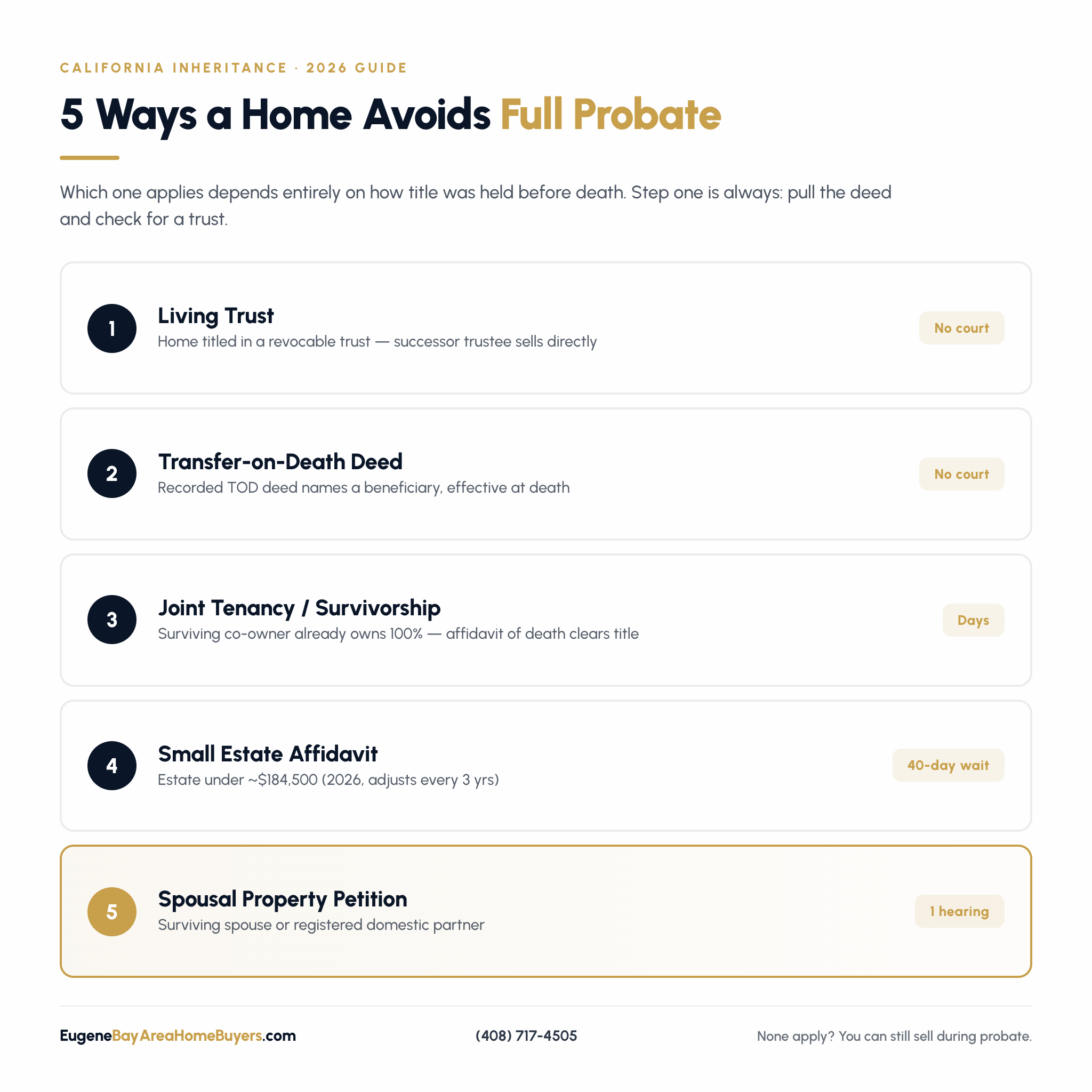
The 5 Ways a California Home Passes Without Full Probate
Here are the mechanisms, what each requires, and the realistic timeline to clear title so you can sell.
1. Living Trust (Set Up Before Death)
The gold standard. The home is titled in the trust; the successor trustee has immediate authority to sell. No court, no delay. If your parent did estate planning with an attorney, there's a good chance this is in place — ask for the trust document.
2. Transfer-on-Death (TOD) Deed
A revocable deed, recorded before death, naming the beneficiary. At death, the named person becomes the owner once they record an affidavit of death. Fast and probate-free, though TOD deeds can be contested by other heirs, so clean family agreement matters.
3. Joint Tenancy / Right of Survivorship
If the deceased co-owned with a surviving spouse or other person "as joint tenants" or "community property with right of survivorship," the survivor already owns 100%. Recording an affidavit of death of joint tenant plus a certified death certificate clears title in days.
4. Small Estate Affidavit (After Death, Under the Threshold)
For estates under the California small-estate limit, heirs can use an affidavit procedure after a 40-day waiting period instead of full probate. Real property of small value has its own affidavit process through the court, which is far faster and cheaper than full probate.
5. Spousal Property Petition (Surviving Spouse)
A surviving spouse or registered domestic partner can use a streamlined Spousal Property Petition to confirm the home passes to them — much faster than full probate, typically a single court hearing.
Once Title Is Clear, Selling Is Straightforward
After title passes to you through any of the routes above, you sell like any other owner — and thanks to the stepped-up basis, the capital gains tax on an inherited home is usually small or zero. For an inherited home, you have two practical paths:
- List with an agent — best if the home is in good condition and you have time to prep, stage, and wait for a retail buyer. Be mindful of holding costs (property tax, insurance, utilities) while the home is empty.
- Sell as-is to a cash buyer — best if the home needs work, you're out of state, multiple heirs want a fast clean split, or the property has sat vacant and is deteriorating. We buy inherited homes as-is with no repairs or cleanout required — see exactly how much cash home buyers pay for the formula.
Inherited homes very often arrive with deferred maintenance, decades of belongings, and sometimes unpaid property taxes or liens. Cash buyers experienced with estate sales handle all of it at closing, which is why so many families choose this route for a parent's longtime home.
What If Full Probate IS Required? You Can Still Sell.
If the home was owned solely by the deceased with no trust, no TOD deed, and the estate exceeds the small-estate limit, you'll need to open probate. But — and this is the part most people don't realize — you can sell the house WHILE probate is open. You don't have to wait for the entire estate to close.
- The court appoints an executor or administrator who has authority to sell estate property.
- Under the Independent Administration of Estates Act (IAEA), many California estates can sell with minimal court involvement — sometimes without a court-confirmation hearing.
- Cash buyers experienced with probate sales coordinate directly with the executor and the probate attorney. We've closed many of these. See our full California probate sale guide for the step-by-step, or our we buy houses in probate page for how the cash purchase itself works — full authority or court confirmation.
Real Bay Area Math: Inherited Home, Two Paths
Scenario: a 1,500 sq ft 1960s ranch in Hayward, inherited by two adult children after their mother passed. The home was in a living trust (so no probate), but it needs a full cosmetic renovation and has 40 years of belongings inside. ARV after renovation: $850,000.
Path A: Clean Out, Renovate, List Traditionally
- Professional cleanout + haul-away: −$6,500
- Renovation (kitchen, baths, flooring, paint): −$78,000
- Holding costs over ~6 months (tax, insurance, utilities): −$15,000
- Agent commissions (5%): −$42,500
- Seller closing costs (2%): −$17,000
- Sale price after renovation: $850,000
- Net split between two heirs: ~$691,000 (after 6-9 months of coordinated work)
Path B: Sell As-Is to Eugene Bay Area Home Buyers
- Cash offer (as-is, belongings and all): $615,000
- Cleanout: $0 (we handle it — leave whatever you don't want)
- Renovation: $0
- Holding costs: $0
- Commissions + closing costs: $0 (we cover them)
- Total time: 14-30 days
- Net split between two heirs: ~$615,000 (in under a month, zero coordination)
The traditional path nets ~$76K more on paper — but only if both heirs can coordinate a 6-9 month renovation across their schedules, front the repair cash, and agree on every decision. For many families, the speed, the clean split, and not having to empty a parent's home by hand are worth more than the gap.
Special Cases
Multiple Heirs Who Don't Agree
If siblings disagree on whether to sell, see our full guide on selling an inherited house with multiple owners — and our guide to partition actions in California for how the court process works and how a cash buyout negotiated between all heirs avoids a court fight.
The Home Has a Mortgage or Reverse Mortgage
A mortgage doesn't block a sale — it's paid off from the proceeds at closing. Reverse mortgages must be repaid (usually within a set window after death) — our guide to selling a house with a reverse mortgage in California walks heirs through that payoff clock — which makes a fast sale especially valuable to avoid penalties.
Out-of-State Heirs
Very common in the Bay Area. You can handle the entire sale remotely — documents are signed electronically or via a local notary, and a cash buyer can manage cleanout and closing without you flying in.
The Home Sat Vacant and Is Deteriorating
Inherited homes that sit empty for months invite the problems we cover in our vacant house guide — insurance cancellation, vandalism, and even squatters. If the home has been empty since the passing, the sooner you act, the fewer of these you'll face.
Title Problems Surface During the Sale
Inherited properties often reveal old liens, unrecorded deeds, or missing-heir issues during the title search. These are solvable — see our title problems guide. A cash buyer experienced with estate sales handles most of these at closing.
Frequently Asked Questions
How long does probate take in California?
Typically 9-18 months, sometimes longer for contested or complex estates. Statutory attorney and executor fees are set by law as a percentage of the estate — on an $850K home that can run $40,000+ combined. Avoiding probate (or using a small-estate shortcut) saves both time and money.
Can I sell the house before probate is finished?
Yes. Once an executor or administrator is appointed, they can sell estate property during probate, often under the Independent Administration of Estates Act with minimal court involvement.
What's the California small-estate threshold?
Around $184,500 as of 2026, but it's adjusted every three years for inflation — verify the current figure with the court or an attorney. If the estate is under the limit, you may use an affidavit procedure instead of full probate after a 40-day wait.
Does a will avoid probate?
No — this surprises many people. A will still goes through probate; it just tells the court how to distribute the estate. Only a living trust, TOD deed, joint tenancy, or small-estate procedure avoids probate.
Do all heirs have to agree to sell?
If the property passed to multiple heirs as co-owners, generally yes — or one heir can force a sale through a partition action. See our multi-owner guide. If it's in a trust, the trustee usually has authority to sell without unanimous heir consent.
Will I owe capital gains tax on an inherited home?
Inherited property receives a "stepped-up basis" to fair market value at the date of death. If you sell soon after inheriting, your taxable gain is usually small or zero. Consult a tax professional for your specific situation.
The house is full of my parent's belongings. Do I have to empty it?
Not if you sell to a cash buyer. We buy as-is, belongings included — take what's meaningful to you and leave the rest. We handle the cleanout. For many families this is the single biggest relief of the whole process.
How does the cash offer get calculated on an inherited home?
Same formula as any cash offer: after-repair value minus repair/cleanout costs minus our holding and selling costs minus our profit. See how cash home buyers pay for the full breakdown.
Get a Cash Offer on an Inherited Bay Area Home
Settling a loved one's home is hard enough without a year of court process and a house full of belongings to sort through. The first step is simple: pull the deed and find out whether the home was in a trust, had a TOD deed, or was jointly held. That one fact usually determines whether you can skip probate entirely.
Call Eugene Bay Area Home Buyers at (408) 717-4505 for a free, confidential consultation. We'll help you understand which path applies, and if a sale makes sense, present a written cash offer within 24-48 hours — as-is, belongings included, cleanout handled. Free, no obligation, no pressure.
We've helped families sell inherited homes in Oakland, San Jose, and Hayward — in a trust, in probate, and everything in between. Whatever the situation, there's a path through it. If you're ready to see a number, our inherited-home cash buyer page has the form and the as-is offer details in one place.


