
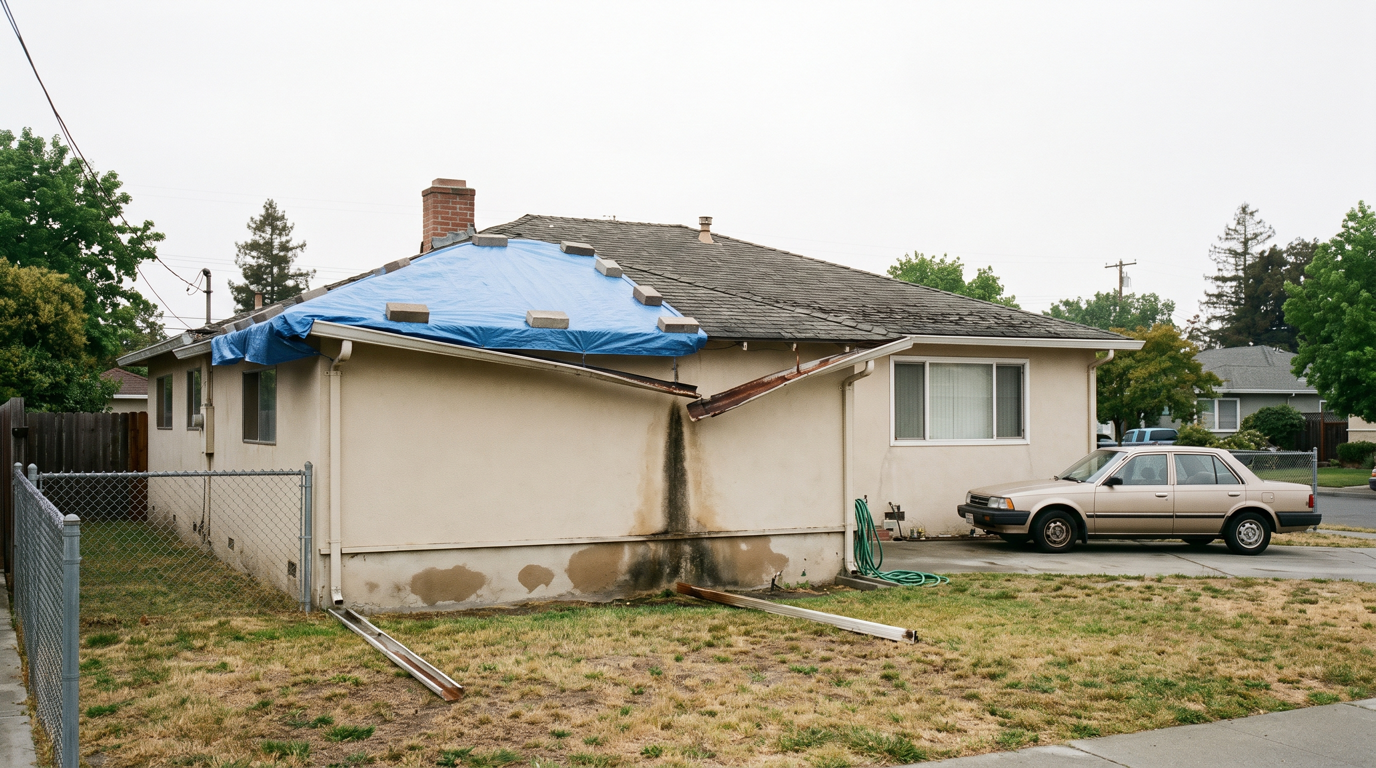
You came home to a sound you couldn't place, or you got the call while you were away, or the January storm found a gap in the roof that had been there for years. Now there is a stain spreading across the ceiling, a section of floor that gives slightly underfoot, and a contractor's estimate that has a comma in it you weren't expecting.
Here is the honest position. Water damage is fixable, and there are three real ways to sell a house that has it — repair it and list, disclose it and list as-is, or sell it as-is to a cash buyer. Which one nets you the most depends almost entirely on one variable: how deep the water went. This piece lays out how to tell, what your insurance will and won't do, what California requires you to disclose, and the real net comparison between the paths. Including the cases where fixing it yourself is plainly the right call.
The reframe: "water damage" is four different problems
Sellers and buyers use one phrase for four situations that have almost nothing in common financially. A cash buyer prices your house by working out which one you have, and you should do the same before you take anyone's advice.
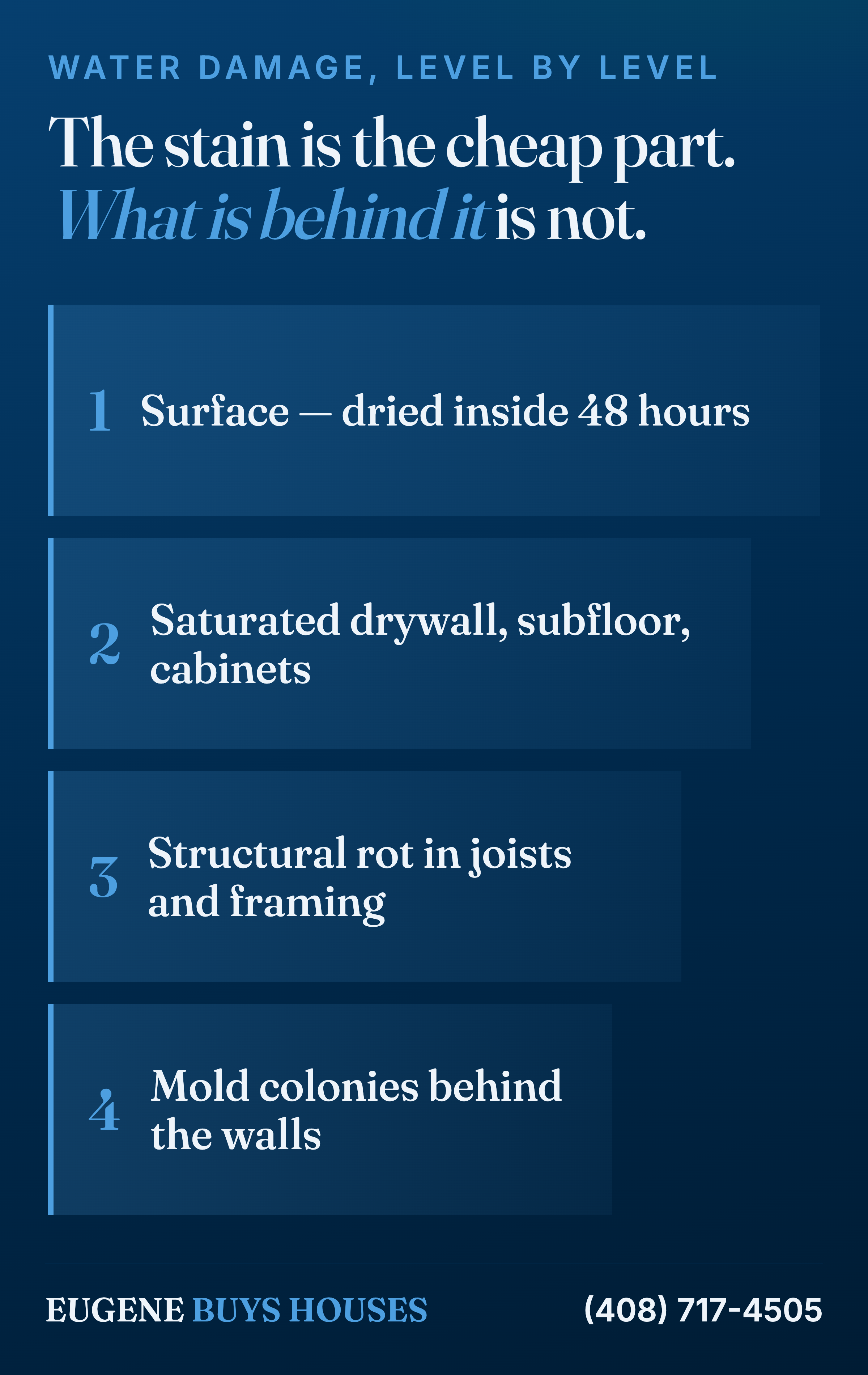
Level 1 — Surface, dried inside 48 hours
A supply line let go, or a window was left open in a storm, and it was extracted and dried within about two days. Finish materials may be stained. Nothing was saturated long enough to delaminate or to grow anything. This is a cosmetic repair, usually a few thousand dollars, and it should not affect your sale strategy at all — repair it, keep the paperwork, and list normally.
Level 2 — Saturated materials
The water sat. Drywall wicked it up from the floor, the subfloor swelled, particle-board cabinet boxes went soft at the toe-kick, and carpet pad held moisture against the slab. Nothing structural has failed, but materials have to be removed rather than dried. This is where costs step up sharply — a saturated kitchen and hallway in a Bay Area house is routinely $40,000 to $90,000 of demolition, materials and labour.
Level 3 — Structural
Water reached framing and stayed. Subfloor sheathing has delaminated, joists or sill plate show rot, or a hillside drainage failure has been feeding a crawl space for years. Often this arrives alongside foundation issues, because the same water that rots a sill plate is usually also moving soil. Structural work needs permits, engineering and an open timeline.
Level 4 — Mold colonisation
Any of the above, left more than about 72 hours in Bay Area humidity, and you also have a biological problem sitting inside wall cavities where nobody can see it. At this point you are no longer selling a water-damage house — you are selling a house with mold, which triggers a different set of buyer fears, lender conditions and disclosure exposure.
Why Bay Area water damage is its own category
Three things make this worse here than in most of the country, and they compound.
The rain arrives all at once. The region gets most of its annual rainfall in a handful of atmospheric-river events between November and March. A roof or a drain that coped for a decade fails in a single week, and every roofer and restoration company in the county is booked at the same moment. Waiting three weeks for mitigation is what turns a Level 2 into a Level 4.
The housing stock is old and built two different ways. Post-war raised-foundation homes have crawl spaces that hide standing water and rotting sill plate for years. Slab-on-grade homes from the sixties and seventies push moisture up through the slab and into the bottom plate and carpet, which reads as a "musty smell" long before it reads as damage.
Hillsides move water sideways. A great deal of Bay Area water damage never came through the roof. It came from a neighbour's uphill drainage, a failed retaining wall, or a French drain that silted up, and it enters at or below grade — which is exactly where a standard homeowner's policy is least likely to pay.
The insurance question, which decides more than people expect
This single distinction determines whether you are looking at a $5,000 problem or a $90,000 one, and it is not intuitive.
A standard homeowner's policy generally covers water damage that is sudden and accidental — a supply line bursting, a water heater failing, a storm opening the roof. It generally excludes damage that was gradual: a slow leak under a sink, a drip that stained a ceiling over two winters, deferred maintenance. Insurers investigate this distinction seriously, because it is where most of the money is.
Three further traps are worth knowing before you count on a cheque:
- Flood is not covered. Rising surface water — creek overflow, storm surge, water entering at grade — is excluded from standard policies entirely and requires separate flood coverage. A great many Bay Area claims are denied on exactly this line.
- Sewer and drain backup usually needs an endorsement. If you didn't add it, a backed-up main is typically your cost.
- Mold is commonly sub-limited. Even when the underlying water event is covered, mold remediation is frequently capped well below its real cost — often in the $5,000 to $10,000 range. Read your declarations page for the actual figure rather than assuming.
If your claim was denied as gradual damage, or you are mid-dispute with your insurer, that does not stop you selling. It changes which path makes sense.
What California requires you to disclose
You cannot quietly repair water damage and sell as though it never happened, and attempting it is how sellers end up in litigation years later.
The Transfer Disclosure Statement required under California Civil Code §1102 for most residential sales of one to four units asks you to disclose known material defects. Past water intrusion is material. So is a repair, and so is a repair that didn't fully work.
The Seller Property Questionnaire goes further and asks directly about past water intrusion, leaks and related repairs — including events that were fixed. "It's repaired now" is not an exemption from disclosing that it happened.
The Natural Hazard Disclosure will independently reveal whether the property sits in a designated flood zone, so a buyer will learn the context regardless of what you say.
The practical consequence is the part sellers miss: disclosing a completed repair still reduces your price. Buyers discount a documented history of water intrusion, and their lenders and insurers sometimes add conditions on top. You do not get to spend $88,000 on repairs and then sell at a clean-house price.
Why traditional sales stall on water-damaged houses
- Financing. An appraiser who sees active moisture, staining or visible mold will typically call for repairs as a condition of the loan. FHA and VA are stricter still. Your buyer pool narrows to cash and conventional-with-reserves.
- The inspection re-trade. Water damage is the single most reliable trigger for a renegotiation after the inspection contingency. Deals that survive the offer stage frequently lose 5 to 8 percent at day fourteen.
- Nobody can price the unknown. Until a wall is opened, neither you nor the buyer knows whether it is Level 2 or Level 4 — and buyers price uncertainty at the pessimistic end, every time.
- Insurability. A property with a recent water claim can be harder for the next owner to insure, and their carrier's quote can arrive late enough to kill the escrow.
Your three real options
Option 1 — Repair, then list
Timeline: three to eight months, longer if permits are involved. Cost: yours, up front, before any sale proceeds exist. Risk: opening the walls routinely reveals more than the estimate assumed, and you still disclose the history afterwards.
This is genuinely the right answer for Level 1 damage, and often for a well-documented Level 2 where insurance paid promptly and you have the cash to front. If your house is otherwise market-ready and the damage is contained, repair it and list it with an agent.
Option 2 — Disclose and list as-is on the open market
Timeline: two to five months. Cost: no repair spend, but you carry the house throughout and you are exposed to the re-trade. Risk: the highest variance of the three. As-is listings with visible water damage attract investor offers with financing contingencies attached — which is the worst of both worlds, since you get the investor price and the retail timeline.
Option 3 — Sell as-is to a cash buyer who prices the damage
Timeline: ten to fourteen days. Cost: nothing out of pocket; we cover closing costs. Risk: the lowest headline number of the three, and we say so plainly. What you are buying with that difference is certainty and speed — no repair spend, no permits, no re-trade, no financing contingency, and in most cases you keep your insurance settlement. This is the same structure we use on fire-damaged houses and it is the core of how we buy houses as-is across California. If this is the path you're leaning toward, our we buy water-damaged Bay Area houses page covers exactly what we buy through — flood, leak, storm and mold — and how the 14-day close works.
Real Bay Area math: a saturated kitchen in Hayward
Scenario: a 1,450 sq ft 1958 ranch in Hayward. A supply line behind the dishwasher failed while the owners were away for four days. Water reached the kitchen, hallway and two bedrooms. Cabinets and subfloor are gone, and mold has started behind the baseboards — a Level 2 sliding into Level 4. After-repair value: $915,000. Insurance accepted the claim as sudden and accidental and settled at $52,000, with mold capped at $10,000.
Path A: repair, then list
- Emergency dry-out and demolition: -$5,000
- Mold remediation: -$18,000
- Kitchen rebuild: -$32,000
- Flooring and subfloor: -$21,000
- Drywall, paint and trim: -$9,500
- Insurance settlement applied: +$52,000
- Holding costs, 5 months: -$19,000
- Sale price after disclosed water history (-3%): $888,000
- Agent commissions (5%): -$44,400
- Closing costs (2%): -$17,760
- Brochure net (sale price less commissions and closing): ~$825,800
- What actually lands, after repairs and holding: ~$773,300
- Timeline: 5-8 months · certainty: low
Path B: sell as-is to Eugene Bay Area Home Buyers
- Cash offer, as-is, damage priced in: $742,000
- Insurance settlement retained by you: +$52,000
- Repairs, remediation, permits: $0
- Holding costs: $0
- Commissions: $0
- Closing costs: $0 — we cover them
- Brochure net: ~$742,000
- What actually lands: ~$794,000
- Timeline: 14 days · certainty: high
The listing path shows the bigger number on the brochure and lands roughly $21,000 less — after you have fronted $85,500 in repairs, waited most of a year, and disclosed the history anyway. And that is the optimistic version of Path A: it assumes the insurer pays in full, that opening the walls reveals nothing worse, and that the buyer doesn't re-trade at day fourteen. Any one of those going differently moves Path A down by tens of thousands. Path B does not move.
One honest caveat on keeping the settlement. If you have a mortgage, your lender is usually named on the claim cheque and may require it to go towards repairs or the loan balance. Confirm that with your servicer before you count the $52,000 as yours — for owners with significant equity or no mortgage it is normally straightforward, and we will structure around it either way.
And when Path A genuinely wins: if your damage is Level 1, insurance paid, and the house is otherwise ready to show, repair it and list. You will net more and the timeline is short. We will tell you that on the call rather than making you an offer you shouldn't take.
Bay Area water-damage houses we've bought
- A Concord ranch with a slab-moisture problem that had been rotting the bottom plate along one whole wall
- A San Jose rental where a second-floor bathroom leaked into the kitchen ceiling below for two winters before anyone noticed
- A hillside home whose uphill neighbour's failed drainage had been feeding the crawl space since the previous owner
- A storm-damaged roof that was tarped for eight months while an insurance dispute ran, by which point the attic was a Level 4
Frequently asked questions
Will you buy a house with active water damage, not just past damage?
Yes. Active is often simpler than historic, because the source is known. We would rather see it wet and know what is happening than inherit a repair somebody rushed.
Do I need a mold test before you'll make an offer?
No. We price on the assumption that any water event over about 72 hours old has mold behind it, so a test rarely changes our number. If you already have one, send it — it can move the offer up.
My insurance claim was denied as gradual damage. Does that kill the sale?
No, though it changes the math, because the repair cost is now entirely yours on the listing path. That is precisely the situation where an as-is cash sale usually wins by the widest margin.
Can I sell while I'm still in a dispute with my insurer?
Usually yes. The claim and the property are separable, and in many cases you can retain your rights to the settlement while transferring the house. Tell us early so we structure it correctly rather than discovering it in escrow.
Do I still have to disclose if I repair everything first?
Yes. The TDS and SPQ ask about past water intrusion and repairs, not just current condition. Disclosing a completed, well-documented repair is the correct move — and it is also why repairing rarely returns the full clean-house price.
How is your offer actually calculated?
After-repair value, minus what the repair will genuinely cost us, minus our margin. We show you the arithmetic. On water damage the repair figure carries a contingency, because the wall has not been opened yet — that contingency is the honest reason the number is lower than the listing path. The full method is in how much cash home buyers pay.
What if the damage turns out to be worse than we both thought?
Our offers on water damage are written to absorb ordinary variance, so a surprise behind the drywall does not become a renegotiation. That is most of what you are buying by selling as-is.
Can you close before the restoration company finishes?
Yes, and often before they start. You are free to stop the work. We would generally rather take the house untouched than pay for a partial remediation.
Get a cash offer on your water-damaged Bay Area house
If the estimate came back higher than you expected, or the claim was denied, or you simply do not want to project-manage a five-month rebuild from a rental, we will look at the house as it is today. The offer is free, there is no obligation, and if repairing and listing would genuinely net you more, we will say so.
Call (408) 717-4505 for a free, no-obligation cash offer. We buy across the Bay Area — including Hayward, Concord and Oakland — and we buy houses with mold, fire damage and foundation problems in exactly the same way: as they stand, with the repair as our problem rather than yours.


