

You inherited a house — from a parent, usually — and somewhere between the grief and the paperwork a new worry crept in: if you sell it, is the IRS going to take a huge chunk? You've heard "capital gains tax" and pictured owing 15% or more of the entire sale price. On a Bay Area home, that's a terrifying number. So before you do anything, you're Googling capital gains tax on an inherited house in California, trying to figure out what you'll actually keep.
Here's the honest, reassuring answer. You are almost never taxed on the full value of an inherited home. Thanks to a rule called the stepped-up basis, your "cost" in the house resets to its fair market value on the day the previous owner died — and you only owe capital gains tax on the amount the home gained after that date. If you sell reasonably soon after inheriting, that gain is often small, and sometimes close to zero. This guide walks through exactly how it works, with real Bay Area math. (One note up front: this is general education, not tax advice — confirm your specifics with a CPA before you file.)
The one rule that changes everything: stepped-up basis
Capital gains tax is a tax on profit — the difference between what you paid for something (your "basis") and what you sell it for. The fear with an inherited home is that your basis is whatever your parent paid decades ago — maybe $80,000 for a house now worth $800,000 — leaving a $720,000 "gain" to be taxed. That would be brutal. But that's not how inherited property works.
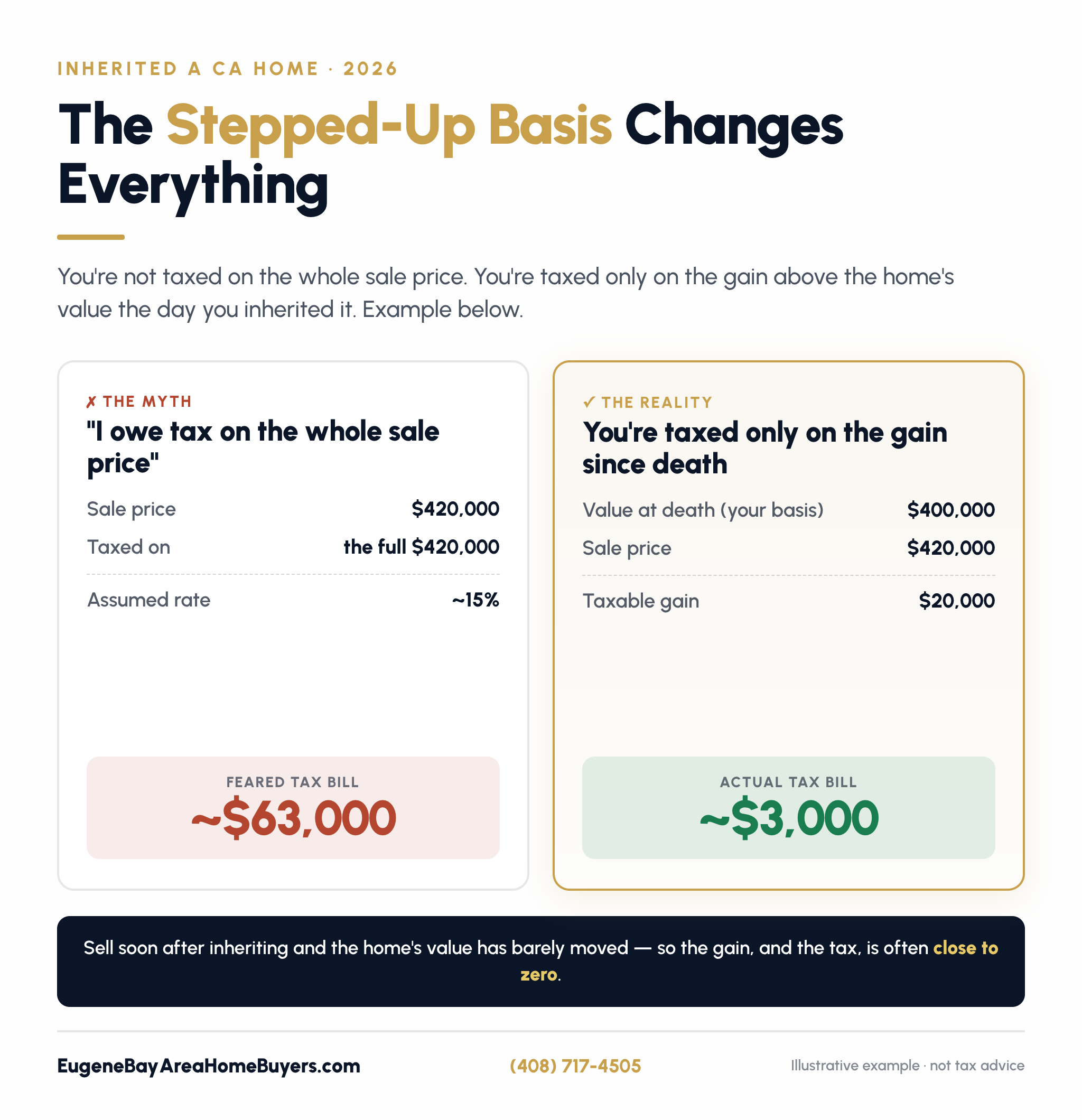
Under federal law (IRC §1014), when you inherit a home your basis is "stepped up" to the property's fair market value on the date of the owner's death. That old $80,000 purchase price disappears for tax purposes. If the home was worth $800,000 the day your parent passed, your basis is $800,000. Sell it for $800,000 and your taxable gain is zero. Sell it later for $840,000 and you're taxed only on the $40,000 of appreciation since the death — not the whole $840,000.
This single rule is why an inherited-home sale is usually far less taxing than people fear. The graphic below shows the myth and the reality side by side.
A real Bay Area example
Say your mother's Hayward home was worth $820,000 on the day she passed. That becomes your basis. A few months later you sell it for $840,000.
- Sale price (amount realized): $840,000
- Your stepped-up basis: −$820,000
- Selling costs (closing costs, any commissions): −$15,000
- Taxable capital gain: about $5,000
Five thousand dollars of gain — not $840,000, and not the decades of appreciation while your mother owned it. At long-term capital-gains rates, the federal tax on that is a few hundred to about a thousand dollars, plus California's share. Compare that to the panic number of "15% of $840,000 = $126,000" and you can see why understanding the step-up matters so much. And notice the selling costs came right off the top — the fees you pay to sell actually reduce the taxable gain.
How California treats it (federal vs. state)
Two layers of tax can apply, and they work differently:
- Federal: Inherited property automatically counts as long-term, no matter how briefly you hold it, so it gets the favorable long-term capital-gains rates — 0%, 15%, or 20% depending on your total income. Many heirs land in the 0% or 15% band.
- California: California has no separate capital-gains rate — the state taxes capital gains as ordinary income (roughly 1%–13.3% depending on your bracket, with most sellers in the ~6%–9.3% range). But remember, this rate applies only to the small gain since death, not the whole sale.
There is no California inheritance tax and no California estate tax, and the federal estate tax only affects estates in the multi-million-dollar range — so for the vast majority of families, inheriting the home itself triggers no tax at all. The only tax in play is capital gains on appreciation after the date of death, if you sell for more than the stepped-up basis.
What makes the gain bigger — or smaller
A few factors move the number:
- How long you wait to sell. The longer you hold after inheriting, the more the home can appreciate above your stepped-up basis — and the more gain you may owe on. Selling soon after inheriting is the simplest way to keep the gain near zero. This is one reason many heirs choose a fast, as-is cash sale rather than holding a property they can't manage.
- Selling costs. Commissions, closing costs, and even certain fix-up costs reduce the amount realized, which lowers the gain. Our breakdown of what closing costs a seller pays in California shows what's deductible against the sale.
- Getting a date-of-death valuation. Your stepped-up basis is only as solid as your proof of the home's value on the death date. A formal appraisal (or strong comps) as of that date protects you if the IRS ever asks how you set your basis. Don't skip it.
- Whether you rented it out. If you held the inherited home as a rental before selling, depreciation you claimed along the way gets recaptured and taxed separately from the gain — and you have the option of rolling the proceeds into another rental instead. Our guide to a 1031 exchange when you sell a California rental walks through when deferring beats simply selling.
- Whether you lived there. If the inherited home was also your primary residence for at least 2 of the last 5 years, you may separately qualify for the Section 121 home-sale exclusion ($250k single / $500k married) — but for most heirs the step-up already erases the gain, so this rarely comes up.
Inherited with siblings? Each of you gets a step-up
When a home passes to multiple heirs, each heir's share gets its own stepped-up basis to the date-of-death value. If three siblings inherit a $900,000 home equally, each has a $300,000 basis in their third. When you sell and split the proceeds, each of you calculates gain only on the appreciation of your share since the death — usually small. The tax rarely drives the decision; the harder part is agreeing to sell, which we cover in selling an inherited house with multiple owners. If one co-owner refuses, that's a separate legal issue — see your options when heirs disagree.
Does selling to a cash buyer change the tax?
No. Your capital gain is driven by the sale price versus your stepped-up basis, regardless of who buys the home. What a fast cash sale does change is the timing — closing within a couple of weeks of inheriting means the home's value has barely moved from the date-of-death figure, which keeps the gain (and the tax) minimal. It also spares you months of holding costs, property taxes, insurance, and maintenance on a house you may be managing from out of town. If the estate is still in probate, you can often still sell — see how to sell a house in probate in California and selling after death without probate for the process, or go straight to our cash buyer page for houses in probate if you want an offer that works on the court's timeline, and if there's a reverse mortgage on the property, that has its own payoff clock.
Frequently asked questions
Do I pay capital gains tax on the full value of an inherited house?
No. Because of the stepped-up basis, your cost is reset to the home's fair market value on the date of the previous owner's death. You only owe capital gains tax on any increase in value after that date. Sell for the date-of-death value and the taxable gain is zero.
What is a stepped-up basis?
It's the rule that resets your tax "cost" in inherited property to its fair market value on the date the owner died — instead of what they originally paid. It's why inheriting and selling a long-held home usually triggers little or no capital gains tax on the decades of appreciation that happened during the owner's life.
Does California have an inheritance tax or estate tax?
No. California has neither an inheritance tax nor a state estate tax. The federal estate tax only applies to very large estates (multi-million-dollar range). For most families, inheriting a home triggers no tax by itself — the only possible tax is capital gains on appreciation after the date of death, and only if you sell for more than the stepped-up basis.
How is the capital gain taxed in California specifically?
Federally, inherited property is always treated as long-term, so it gets long-term capital-gains rates (0%, 15%, or 20% based on your income). California has no special capital-gains rate — it taxes the gain as ordinary income. But both apply only to the (usually small) gain since the date of death, not the sale price.
How do I prove the home's value at the date of death?
Get a formal appraisal as of the date of death, or keep solid comparable-sales records for that time. This establishes your stepped-up basis and protects you if the IRS ever questions your numbers. It's worth doing before you sell.
If I sell quickly, will I owe almost nothing?
Usually, yes. Selling soon after inheriting means the home's value has barely changed from your stepped-up basis, so there's little gain to tax — and selling costs reduce it further. Waiting years lets the home appreciate above your basis, which can create a larger taxable gain.
My siblings and I inherited the house together. How is each of us taxed?
Each heir's share receives its own stepped-up basis to the date-of-death value. When you sell and divide the proceeds, each person calculates gain only on the appreciation of their share since the death — typically small. The tax is rarely the obstacle; agreeing on the sale usually is.
Does selling to a cash home buyer increase or decrease my taxes?
Neither — the tax depends on the sale price versus your basis, not the type of buyer. A cash sale can reduce your gain indirectly by closing fast (so the home hasn't appreciated much past the date-of-death value) and by saving you months of holding costs. Your offer amount is calculated the same way for any seller; see how cash home buyers calculate offers for the full breakdown.
The honest bottom line
The capital gains tax on an inherited California home is almost never the monster it feels like at first. The stepped-up basis resets your cost to the home's value on the date of death, so you're taxed only on what it gained afterward — often a small amount, and sometimes nothing. There's no California inheritance or estate tax, selling costs come off the top, and selling sooner rather than later keeps the gain minimal. The tax should rarely be the reason you hesitate to sell.
If you'd like to know what you'd actually net on an inherited Bay Area home — after any capital gains and selling costs — tell us the address and roughly what it's worth, and we'll walk you through a real number with no obligation. We buy inherited homes as-is, can close in as little as two weeks, and coordinate directly with your attorney or the estate. Call (408) 717-4505 for a free, confidential conversation. We buy across the Bay Area, including Hayward, Oakland, San Jose, and Richmond — and please still confirm your specific tax situation with a CPA before you file.


