
You typed "Opendoor" into Google. Maybe you saw their ads, or a neighbor mentioned getting an "instant offer," or you just wanted to skip the whole MLS-and-realtor song-and-dance. The pitch was always seductive: type your address, get a cash offer in a day, close in a couple of weeks, never list. Worth knowing what a cash offer really means before comparing any two of them. For a window of years it was a real option in the Bay Area. In 2026, the picture has shifted — and most of the articles you'll find ranking for "Opendoor reviews" are two or three years out of date. (If reading the reviews is what brought you here, we wrote that up separately in what Bay Area sellers actually report about Opendoor; this page is the offer-versus-offer decision.)
One quick clarification before we dig in, because it trips up a lot of sellers: an iBuyer like Opendoor is a real company buying with its own money, which makes it very different from a wholesaler who only assigns your contract to someone else. This guide compares you against a funded buyer — but when you're collecting offers, it's worth knowing which kind of "cash buyer" you're actually talking to. The full map — iBuyer vs national franchise vs wholesaler vs local cash buyer, and what each model really pays — is in our guide to home-buying companies in the Bay Area, and the franchise branch of it is covered on its own in what a We Buy Ugly Houses offer looks like in the Bay Area.
Here's what's actually true right now, what an iBuyer offer would look like on a typical Bay Area home, when one might still make sense, and the three other paths that almost always beat it for Bay Area sellers — including a local cash buyer like us. No pitch. Just the numbers.
First, the 2026 reality: Offerpad is gone, Opendoor still works but on tighter terms
The 2020-2022 iBuyer boom is over. Zillow Offers shut down in late 2021. Offerpad wound down its California operations and is not actively buying in the Bay Area as of 2026. Opendoor is still the one major iBuyer operating in the Bay Area, but with a much narrower service footprint than it had in 2021 and noticeably more conservative pricing.
What that means practically:
- Opendoor will give you an instant offer on a "qualifying" home (single-family, suburban, built after a certain year, no major repairs) in selected Bay Area zip codes. They're picky about which homes they'll touch.
- Offerpad's site may still accept a Bay Area address, but in practice the offers are limited or routed to partner buyers — they're not the volume buyer they once were here.
- "iBuyer" as a category is now smaller, more selective, and slower than it was. The "instant" in "instant offer" is real on speed; the offer amount is the part that's gotten more conservative.
Why? Because iBuyers got badly burned on inventory they bought at 2021 peak prices. They learned to underwrite more carefully. The model didn't die — it just became less aggressive. Good for them, less good for the seller hoping for an aggressive offer.
How an iBuyer offer actually works — the part most articles skip
The number Opendoor (or any iBuyer) puts in front of you is not what you'll net at closing. Three layers come out of it before the wire hits your account:
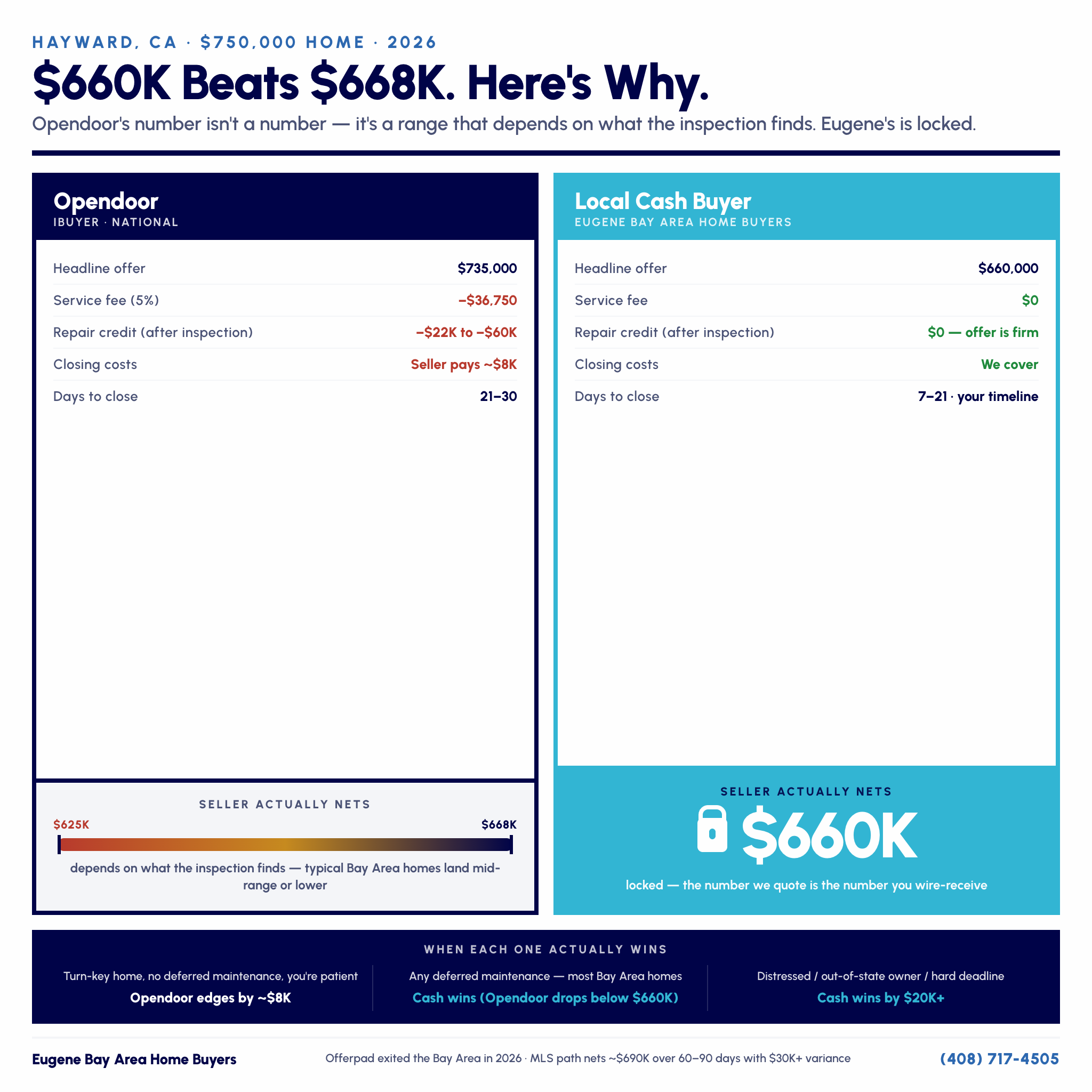
- The service fee. Opendoor charges roughly 5% of the offer price as their service fee. This replaces the agent commission you'd pay on an MLS sale, but it's a flat fee, not negotiable in the way a listing-agent commission sometimes is.
- The repair credit. After the initial offer, Opendoor sends an inspector through. Then they come back with a "repair credit" — basically a list of items they're going to deduct from the offer to account for work they'll have to do before reselling. This number is sometimes small (a few thousand dollars), sometimes catastrophic (we've seen it knock $20,000-$40,000 off a Bay Area offer when the inspection flagged foundation, roof, or termite issues). The seller doesn't see the repair-credit estimate until after the inspection, by which point they're already mentally committed.
- Closing costs. The seller still pays standard closing costs (transfer tax, escrow fees, title) — Opendoor doesn't absorb these.
So the gap between the headline "offer" and what you actually walk away with is typically 8-12% of the home value, sometimes more.
Your 4 real options in 2026 — and when each one wins
There is a fifth worth naming: selling it yourself. It saves less than most owners expect, because the buyer's agent still generally gets paid — but for a market-ready home with a patient owner it can beat all four.
For any Bay Area seller in 2026, there are really four paths. We'll be honest about which path wins for which situation:
Option 1: List with a Bay Area agent on the MLS (the traditional path)
You hire an agent, prep the home, list it, do showings, get offers, negotiate, open escrow, close in 30-45 days. This still wins on absolute price — a well-presented Bay Area home on the MLS routinely sells at or above asking, especially in the Tri-Valley and Peninsula. But it costs you: 5-6% in commissions, 1-3% in pre-listing repairs and staging, 1-2% in closing costs and concessions, and 30-90 days of carrying costs and uncertainty. Best for: turn-key homes in desirable neighborhoods with no urgency.
Option 2: Sell to Opendoor (the iBuyer path)
You enter your address on Opendoor's site, get an instant offer, accept it, schedule an inspection, receive a repair credit, sign, close in 14-30 days. The convenience is real but it's not the price-leader. The 2026 Opendoor offer on a $750K Bay Area home typically nets the seller 85-90% of fair market value after the service fee + repair credit + closing costs come out. Best for: turn-key homes where the seller values speed and convenience over maximum price, in zip codes Opendoor still actively buys in. For how iBuyers stack up against every other way to sell — ranked by days-to-close — see how to sell a house fast in the Bay Area.
Option 3: Sell to a local Bay Area cash buyer (our path)
You contact a local cash buyer (like us — Eugene Bay Area Home Buyers), share basic info about the property, get a no-obligation cash offer in 24-48 hours, close in 7-21 days on your timeline. The offer is usually similar to an iBuyer's headline number — sometimes a bit lower, sometimes higher — but there's no service fee, no repair credit deducted later, no inspection contingency that can re-trade you, and we pay all standard closing costs. The number we say is the number you net. Best for: anything iBuyers won't touch (distressed, inherited, vacant, fire-damaged, foundation issues, code violations, hoarder), out-of-state owners, sellers who need certainty on the close date, sellers who want one number instead of a moving target.
Option 4: For sale by owner (FSBO)
You list it yourself. In 2026 Bay Area markets this is a money-loser for most people — you save the 2-3% buyer's-agent commission you'd have paid, but you give up roughly the same in the discount buyers expect from a non-MLS listing, plus you take on all the showing, paperwork, escrow coordination, and disclosure liability. Best for: a very narrow case where the seller is also a licensed agent or has handled multiple transactions before.
Real Hayward math: a $750,000 home, all four paths
This is a representative scenario, not a quote. Numbers will move with your specific home, neighborhood, and condition. But for a $750,000 Hayward single-family home in average condition (some deferred maintenance — a 15-year-old roof, original water heater, kitchen needs cosmetic update), here's roughly how each path nets out.
Two of these four "net to seller" numbers are fixed. Two are ranges. A lot of sellers see "$668K Opendoor vs $660K cash" and instinctively pick the higher number — which is the wrong way to read the math.
- MLS: expected value with ±$30K variance both ways. The sale could be $30K higher OR $30K lower than the table number.
- Opendoor: best-case number. After the inspection comes the repair credit, which on typical Bay Area homes drags the actual net into the $625K–$650K range, not $668K. You don't find out until you've already mentally committed.
- Local cash buyer: firm. $660K means $660K. No inspection re-trade, no surprises.
- FSBO: expected value with ±$20K variance — usually under.
So the real Opendoor-vs-cash comparison isn't $668K vs $660K. It's "$625K–$668K range" vs "$660K locked" — and the cash number sits at or above the typical Opendoor outcome.
How to read this: the "Headline net" column is what each option's marketing tells you. The "Real-world net" column adjusts for what typically happens — carrying costs while you wait, post-inspection repair credits, market variance. At the real-world level, the only path that guarantees the number is the cash buyer — and on most Bay Area homes it's at or above the typical realized outcome of MLS or Opendoor, in a fraction of the time, on any condition.
Read the table honestly. The MLS path wins on absolute net — by about $22,000 over an Opendoor sale and $30,000 over a direct cash buyer. If the home is in good condition, the seller has 60-90 days, and they don't mind the prep work and showings, listing is the right call.
What the table doesn't show is the variance and the certainty. The MLS number is an expected value — the actual sale price could be $30K higher OR $30K lower, the close date could slip 30+ days, and a buyer can re-trade you after their inspection. The Opendoor number can move $20K against you after their inspector visits. The cash-buyer number is the only one that doesn't move — we tell you $660K, you get $660K, on the day we agreed to. For some sellers (out-of-state owner of an inherited property, someone facing a deadline, someone with a property no iBuyer will touch), that certainty is worth $30,000.
When an iBuyer offer (or a cash buyer) actually beats the MLS
The cash path — whether iBuyer or local cash buyer — wins clearly in five situations:
- The home isn't MLS-ready. Foundation issues, fire damage, mold, code violations, hoarder condition, vacant for years, squatter eviction in progress. iBuyers won't touch most of these. Local cash buyers will.
- You're not local. Inherited a Bay Area home and live in another state. Managing repairs, listing, showings, and 60-day escrow from 2,000 miles away is brutal. Cash close in 14 days, no in-person required, is the rational choice.
- You're on a deadline. Job relocation, divorce, debt deadline, pre-foreclosure auction date approaching. The MLS path is too slow.
- You can't afford the carry. Empty home in the Bay Area costs $3K-$8K/month in mortgage, insurance, taxes, utilities, and risk. 90 days on the MLS = $9K-$24K in carry. That eats into the "higher" MLS net fast.
- You want certainty over upside. Some sellers value the locked-in number more than the chance of $30K more (or less). That's a values choice — both are valid.
If none of those five fit you, list. Honestly. We'd rather you sell to an MLS buyer for more than rush you into a cash close that wasn't right for your situation. We get plenty of business from the sellers for whom cash is right.
Special cases worth flagging
Condos
Opendoor will buy some Bay Area condos but is much pickier than on single-family. HOA financials, building reserves, and the condo's age all factor in. A local cash buyer is usually faster to clear on a condo because we're not running it through a national underwriting model.
Investor-owned with tenants in place
Opendoor won't buy a tenant-occupied home. Most iBuyers can't — their model requires a vacant unit they can re-list. A local cash buyer can structure the deal around the tenancy: take it subject-to-tenant, time the close to the lease end, or include a cash-for-keys arrangement. Selling a rental with tenants in the Bay Area walks through the options.
Fixers (foundation, fire, mold, code violations)
Out of scope for iBuyers, period. Local cash buyers specialize in these — we've bought homes with foundation issues, fire damage, mold, and unpermitted work.
Distressed (foreclosure, probate, divorce, bankruptcy)
iBuyers are buying real estate; they're not specialists in distressed-sale logistics. Local cash buyers regularly close on homes in pre-foreclosure, probate, divorce, or bankruptcy — we understand the court approvals, the timing constraints, and the trustees.
FAQ: 8 questions Bay Area sellers ask about Opendoor and cash buyers
Is Opendoor still buying in the Bay Area in 2026?
Yes, but in a much narrower set of zip codes and on more conservative terms than they offered in 2021-2022. Their service-area map shrinks and expands; the only way to know if your address qualifies is to enter it on their site. Even if you qualify for an initial offer, expect the post-inspection repair credit to take 4-7% off that initial number.
Is Offerpad still operating in the Bay Area?
Not actively as of 2026. They wound down most California operations. Their site may still accept an address but the offers are limited or routed to partner buyers — not the direct iBuyer experience they offered previously.
What's the real difference between an iBuyer and a "we buy houses" cash buyer?
iBuyers are large national companies (Opendoor) that use algorithms to make instant offers on a narrow band of "qualifying" homes — typically turn-key suburban single-family in good condition. They make money by reselling on the MLS shortly after buying. Cash buyers (us) are local companies that buy a much wider range of properties — including condition issues, distressed situations, and locations iBuyers skip — and make money by renovating, holding as rentals, or wholesaling. iBuyers are fast and structured but selective. Cash buyers are flexible and can handle the hard cases.
Will I net more selling to Opendoor or to a local cash buyer?
It depends on the specific home. For a clean, turn-key Bay Area single-family in a zip code Opendoor likes, their initial offer may be higher than a local cash buyer's. But after Opendoor's service fee + post-inspection repair credit + your closing costs come out, the two paths typically net within $5K-$15K of each other. For any home with condition issues, location issues, or tenant issues, a local cash buyer almost always nets more (because Opendoor either won't buy or will hit it with a brutal repair credit).
How fast can each option actually close?
Opendoor: 14-30 days from accepted offer. Local cash buyer (us): 7-21 days, typically faster than Opendoor because we don't have national-underwriting layers. MLS: 30-45 days after you get an accepted offer, which itself can take weeks. FSBO: 60+ days typically.
Are cash home buyers legitimate? How do I avoid getting scammed?
The cash-buyer industry has legitimate operators (BBB-accredited, licensed, real reviews, real address, years in business) and a tail of opportunists. Vet anyone you're considering: real business address, real license, real reviews from real names, proof-of-funds letter on request, no upfront fees, no high-pressure tactics, walk-away clause in the contract. We're putting together a full vetting guide later this month — see our overview of whether "we buy houses" companies are legit in the meantime.
What if my home needs major repairs?
Opendoor will typically refuse to buy or deduct a large repair credit. We buy in any condition — as-is sales are most of what we do. We've bought hoarders, fixers, fire-damaged, mold, foundation issues, you name it. No repair credit deducted later; the offer we make is the offer we close at.
Do I have to pay closing costs?
With Opendoor, yes — standard seller closing costs come out of your proceeds. With us, no — we cover all standard closing costs. That's typically a $5K-$10K difference on a Bay Area home.
The honest summary
If your home is turn-key, you have 60-90 days, and you want maximum dollars, list it on the MLS with a Bay Area agent. The numbers favor it.
If your home is in a zip code Opendoor still buys in, you value the structured speed, and you're okay with a moving offer (initial → post-inspection), Opendoor is a real option in 2026. Not the price leader, but a real option.
If your home has any condition issues, you're out of state, you're on a deadline, or you simply want certainty over upside — a local Bay Area cash buyer is almost always the right call. Here's how we calculate offers honestly, and here's how cash compares to an agent listing in more detail.
If you'd rather skip all this and just find out what your home is worth to us, call (408) 717-4505 or fill in your address — free, no obligation, real number in 24 hours. We work across the Bay Area including Oakland, San Jose, Hayward, and most surrounding cities.