Roughly 14,800 people a month search "Opendoor" in this market. About 480 of them search "Opendoor reviews," another 110 search "is Opendoor legit," and 70 search "Opendoor fees." That pattern is not idle curiosity. It is people holding an offer and trying to work out whether to sign it.
So let's deal with the easy question first and then spend the rest of the page on the useful one.
Is Opendoor legitimate? Yes. It is a publicly traded company that has bought and resold tens of thousands of homes, with real money, real escrows and real closings. Whatever the one-star reviews say, "it's a scam" is not what is going on.
The useful question is different: when a Bay Area seller's experience goes badly, what specifically goes wrong — and is it the kind of thing that would happen to you? That is a question you can actually answer from reviews, if you read them properly. This page is how.
A disclosure before we start: we are a local cash buyer based in San Jose, so we compete with Opendoor. We have written the comparison of the two offers elsewhere, in cash offer vs Opendoor and Offerpad in the Bay Area. This page is deliberately not that. This one is only about reading the reviews.
Why a star average tells you almost nothing
We're not going to quote you today's rating, because it moves, it differs by platform, and a number we publish in September is wrong by December. Go and look at Trustpilot, the BBB profile, the Opendoor subreddit and Yelp yourself. What matters is how you read them once you're there.
Four things distort every review average for a company like this one:
- Reviews are bimodal. People write when they are delighted or furious. The enormous middle — "it was fine, slightly under market, closed on time" — mostly says nothing at all.
- Buyers and sellers are mixed together. Opendoor also sells houses, and a buyer's experience has nothing to do with yours. Filter to sellers or you are reading someone else's transaction.
- The company being reviewed changed. Reviews from the 2021 boom describe an aggressively priced, expansion-phase iBuyer. Reviews from the years after describe a much more conservative one. A review older than about eighteen months is history, not evidence.
- Many prompts land at the wrong moment. Review requests often arrive after a pleasant early interaction rather than after closing — so the friction, which happens later, is under-represented.
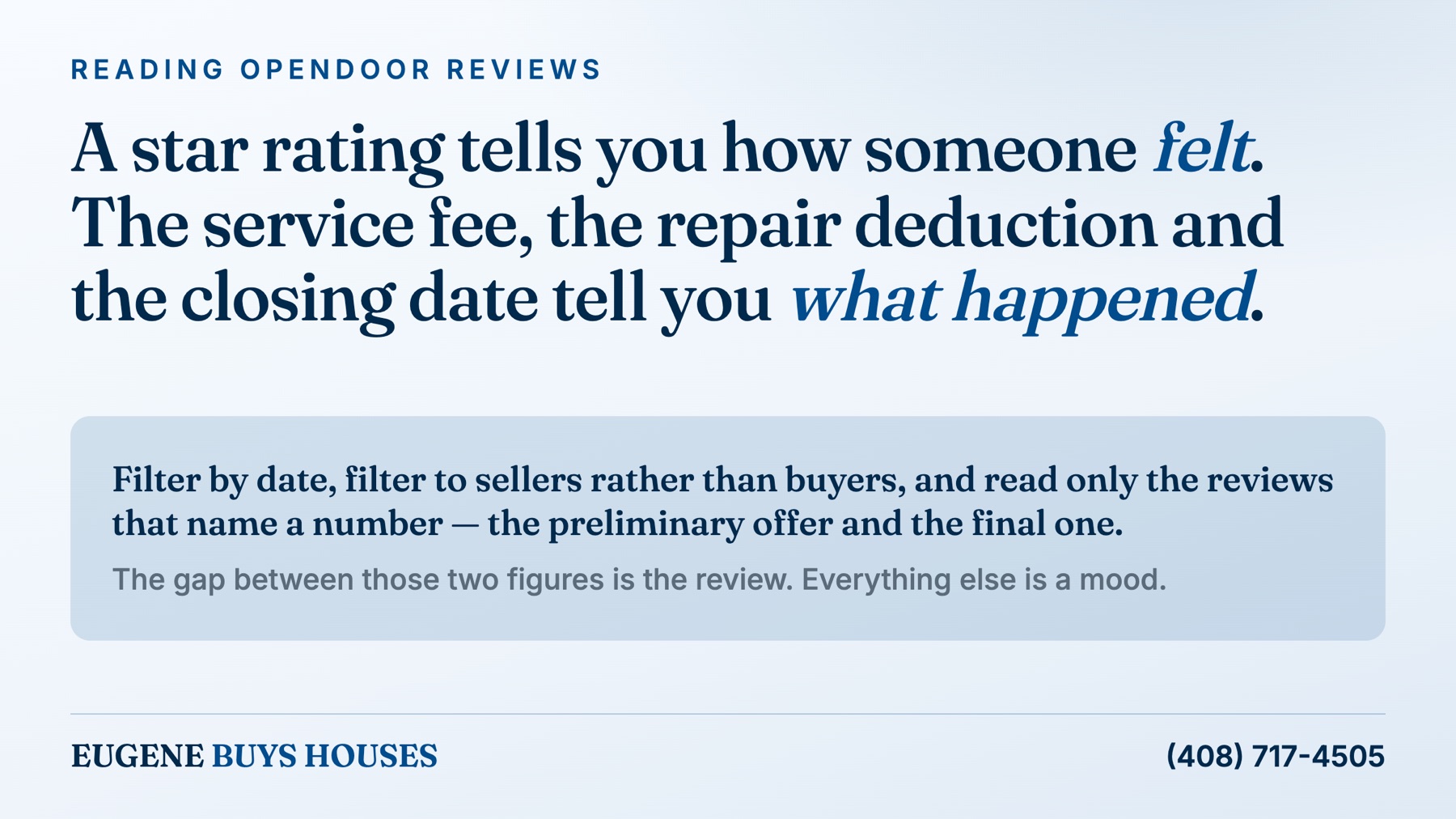
Which is why the instruction is: ignore the average, sort by recent, filter to sellers, and read for specifics. A review that names a preliminary offer, a final offer and a fee is worth fifty that say "great experience."
The five things Bay Area sellers actually describe
Read enough of them and the same five themes come back. None of these is a scandal — each is a direct, predictable consequence of how the model works, which is exactly why they recur.
1. The gap between the preliminary offer and the final offer
This is the single most common complaint in the genre, and it is structural. The first number is produced by an algorithm from public data before anyone has seen your house. Then an assessment happens, and the number is revised down by whatever that assessment finds.
The revision is not itself unreasonable — no buyer can hold a price sight-unseen. What sellers object to in review after review is the framing: the first number was presented with enough confidence that they stopped talking to other buyers, and the second one arrived after they had mentally sold the house. If you take nothing else from this page: treat a preliminary iBuyer offer as an estimate, and keep your other conversations warm until the final one is in writing.
2. The service fee
The fee is disclosed, it is in the paperwork, and sellers still write about it constantly — because a percentage is an abstraction until it becomes a five-figure line on a settlement statement. On Bay Area prices, a service fee in the mid-single-digit percentages is a very large number.
The mistake to avoid is comparing an iBuyer's headline offer against a direct buyer's headline offer, when one has a fee coming off and the other does not. Compare net to net, always. Our home sale proceeds calculator is built for exactly that comparison.
3. Repair credits after the assessment
The second deduction, and the one that generates the most detailed complaints. After the assessment, a repair figure comes off — and sellers routinely report that the figure exceeded what they believed the work was worth, or covered items they considered normal wear.
The underlying reason is not malice. An iBuyer is going to renovate and resell the house, so it prices repairs at what a company pays a contractor at scale, not at what a homeowner would spend to make something tolerable. Those two numbers are simply different, and on older Bay Area housing stock they are very different. Ask for the line items. A company confident in its number will show you; the request costs you nothing.
4. The closing date moving
"Close on your schedule" is the promise, and most of the time it holds. When reviews say it didn't, it is usually title work, a lien nobody knew about, or an internal reschedule. It matters more than it sounds when you have already signed a lease or booked movers.
The protective question is simple: what happens if you need to move the date? Ask it before you sign, and get the answer in writing.
5. The offer that never came at all
The quietest theme, and the most Bay Area of the five. An enormous share of local homeowners never get to complain about the fee, because the algorithm declines the house outright.
iBuyer buy-boxes want homes built after a certain year, conventional floor plans, no foundation questions, no major systems work, no unpermitted additions and a price inside a defined band. Much of the East Bay and the Peninsula fails at least one of those. A 1952 San Jose ranch with a converted garage, a Fremont house with knob-and-tube upstairs, a hillside property with a retaining wall — these do not get lowballed, they get no offer. That is why so many "Opendoor review" threads from this region are really about never having been eligible.
How to read any iBuyer review in five minutes
- Sort by most recent. Anything older than eighteen months describes a different pricing posture.
- Filter to sellers. If the reviewer bought a house, their experience is irrelevant to you.
- Look for two numbers. Preliminary offer and final offer. A review with both is evidence; a review with neither is a mood.
- Check whether it closed. A furious review about an offer someone declined is not a review of the company's conduct at closing.
- Read the company's replies. How a business answers its worst reviews is more informative than the reviews themselves — and that is a test you should apply to us as well.
That last point generalizes. The checks that work on a national iBuyer, a franchise and a one-person local buyer are the same checks, and we set all of them out in how to tell whether a Bay Area cash home buyer is legitimate.
Six questions to ask before you accept any instant offer
- Is this number final, or subject to revision after the assessment? Get it in writing.
- What is the service fee, in dollars? Not as a percentage. Dollars.
- Who decides the repair deduction, and can I see the line items?
- What is my estimated net at closing after fee, repairs and seller closing costs?
- What happens if the closing date slips — on either side?
- Can I cancel, when, and does it cost me anything?
Those six answers, on paper, are worth more than every review on the internet. And a buyer who hesitates on any of them has answered a seventh question you didn't ask.
Where a local cash buyer actually differs — including where we don't win
Since we compete with them, here is the honest version.
Where Opendoor is genuinely better: a newer, clean, conventional house that fits the buy-box. The headline offer is the closest to market value of any instant-offer model, the process is slick, and if the fee and the repair deduction land modestly, the net can beat a local buyer's flat number. If that describes your house, get their quote. We would.
Where the local model is different:
- One number, not two. The figure we quote after walking your house is the figure at closing. There is no second algorithmic pass.
- No service fee. Nothing comes off afterwards, and we pay the standard seller closing costs.
- Repairs are priced by someone local. Bay Area contractor rates, on Bay Area housing stock, by people who have done that exact repair in your city.
- No buy-box. The houses the algorithm declines are most of what we buy.
- A person, not a portal. The one who prices it is the one whose money buys it.
And the honest cost of all that: a local cash offer is below market, openly and by design, because it absorbs the repairs, the resale risk and the holding period. We publish the arithmetic rather than asking you to trust it — it's in how much cash home buyers actually pay. If you want the wider map of who else is bidding, the four kinds of home-buying company covers it, and the national franchise branch has its own page in what a We Buy Ugly Houses offer really looks like here.
Questions Bay Area sellers ask about Opendoor
Is Opendoor legit?
Yes. It is a publicly traded company that genuinely buys homes with its own capital and closes through normal escrow. The complaints in reviews are about price, fees and repair deductions — not about whether the transaction is real.
What are Opendoor's fees?
A service fee taken as a percentage of the purchase price, plus deductions for repairs identified at assessment, and you still pay the seller closing costs that any sale carries. Ask for all three as dollar figures before you decide, because the percentage is the part that feels small.
Does Opendoor lower the offer after the inspection?
It is the most frequently described pattern in seller reviews, and it follows from the model: the first number is algorithmic and sight-unseen, the assessment produces the revision. Expect a revision and ask what drives it, rather than being surprised by one.
Is Opendoor still buying in the Bay Area?
Opendoor is the one major iBuyer still active here, with a narrower footprint and more conservative pricing than at the 2021 peak. Offerpad wound down its California operations. The current state of both is covered in our Opendoor and Offerpad comparison.
Why did Opendoor decline my house?
Almost always the buy-box: age, unpermitted work, foundation or systems questions, an unusual floor plan, or a price outside their band. It is not a judgment on the house — plenty of the homes they decline are perfectly good houses, and they are most of what a local buyer purchases.
Opendoor or a local cash buyer — which pays more?
Net of everything, an iBuyer usually wins on a clean, newer, conventional house and a local buyer usually wins on anything with real condition or complexity. Get both numbers. It costs an afternoon and it is the only way to know which case yours is.
Can I cancel an Opendoor contract?
There are cancellation terms and they are in the agreement — read them before you sign rather than after, and ask specifically whether canceling costs you anything. That advice applies to every buyer, including us.
Get the second number
If you already have an instant offer, the most useful thing you can do is put a second real number next to it. Not to switch — to know.
Call (408) 717-4505 and we will give you a straight local number on your Bay Area house — from Dublin to Fremont to San Jose — with the repair math shown and proof of funds attached. It is free and there is no obligation. And if their offer nets you more once the fee and the deduction are in, we will tell you to take it.