
Search "deed in lieu of foreclosure" and you get the CFPB, Rocket Mortgage, Bank of America, Investopedia, and a scattering of law firms in Florida, Texas and New York. Every one of them explains the mechanism competently. Not one of them answers the question a Californian in trouble is actually asking, which is:
Should I do this, or should I sell the house instead?
That question has a California-specific answer, and for most Bay Area homeowners it is not the one the lender's letter implies. Here is the honest version.
What a deed in lieu actually is
A deed in lieu of foreclosure is a voluntary agreement: you sign the title of your house over to your lender, and the lender agrees to accept the property in place of foreclosing on it. You move out. The lender takes the house and whatever it is worth. The foreclosure case never gets filed.
Three things follow from the word voluntary, and they are the whole decision:
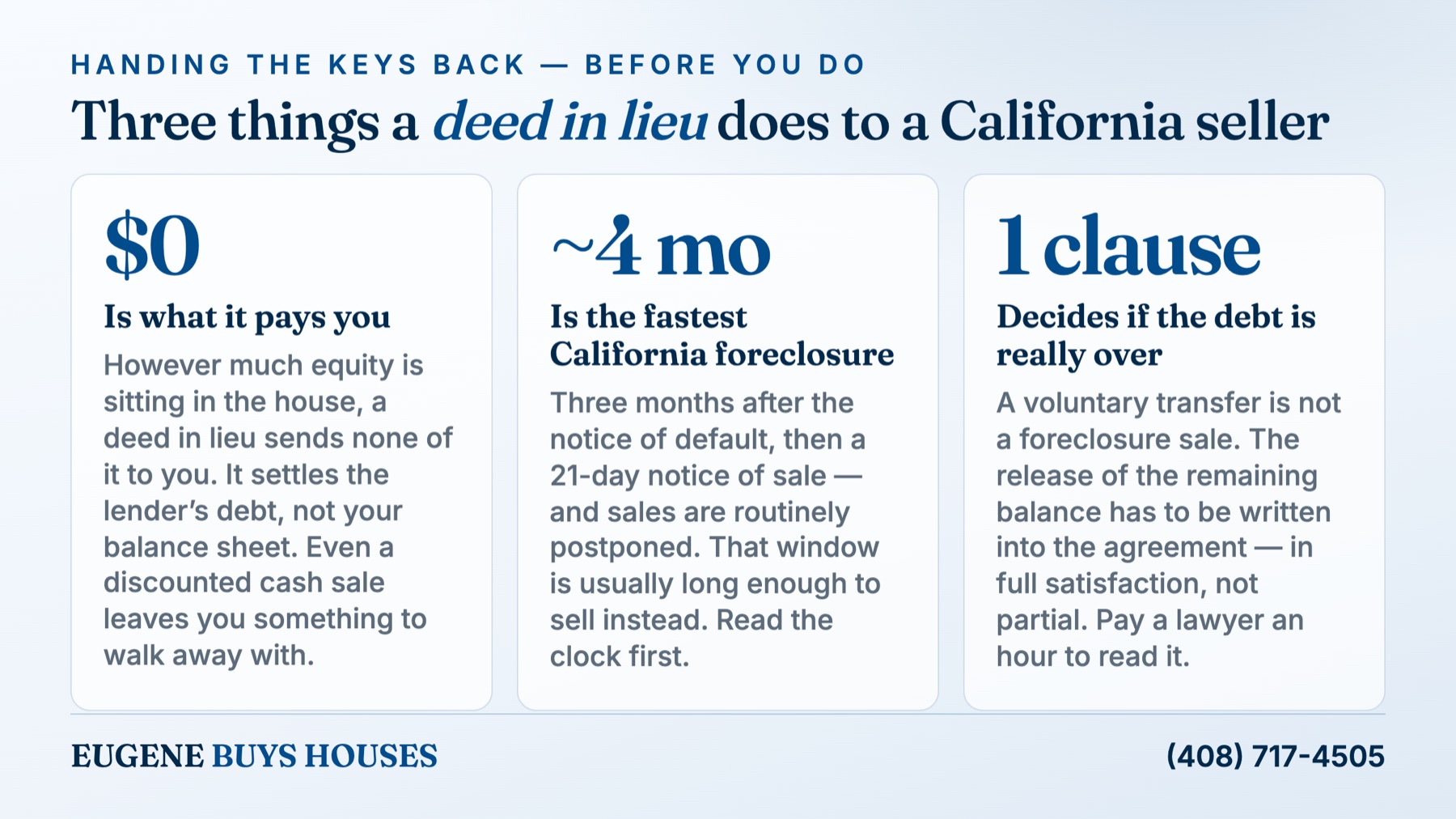
- You receive nothing at closing. There is no sale price, no proceeds, no escrow check. If your house is worth $300,000 more than you owe, you are gifting the lender $300,000 of your money to settle a debt that the house itself would have covered.
- The lender has to agree. A deed in lieu is not a right you can exercise. Servicers routinely decline them, and the usual reason is the one in the next section.
- It is a contract, not a statute. What happens to the unpaid balance depends on what the agreement says — not on the anti-deficiency protections that attach automatically to a foreclosure sale.
The three California traps
1. Junior liens do not disappear
This is the reason most deed-in-lieu requests get refused, and almost nobody explains it plainly. When a first-position lender forecloses, junior liens attached to the property are generally wiped off the title by the sale. When you hand over a deed voluntarily, there is no sale to wipe anything out — the lender takes the house with the second mortgage, the HELOC, the HOA lien, the judgment lien and the tax lien still recorded against it.
No lender wants that. So if you have a second mortgage or anything else recorded — which in the Bay Area, after two decades of HELOCs, is extremely common — expect the answer to be no, or expect to be asked to clear the junior liens yourself first.
2. The deficiency is a clause, not a protection
California has strong anti-deficiency rules, and they are why so many homeowners here believe the balance simply vanishes. Part of that protection is genuinely broad. Code of Civil Procedure § 580b bars a deficiency judgment "in any event" on a purchase-money loan secured by an owner-occupied home of four units or fewer — and "in any event" is not tied to a foreclosure sale. So if the loan is the original purchase-money loan on the home you live in, that protection may still apply to a voluntary transfer.
"May" is doing real work in that sentence. Most Bay Area mortgages are no longer purchase-money: a refinance, a cash-out, a HELOC or a second taken out years later generally sits outside § 580b altogether. And the other main shield, § 580d, is written specifically around the trustee's sale under a deed of trust — a deed in lieu is not a trustee's sale, it is a negotiated transfer, so § 580d does not do the work here.
Which is why you do not let the statute stand in for the paperwork. The release of the remaining balance should appear in writing, in the agreement: language saying the deed is accepted in full satisfaction of the debt and that the lender waives any deficiency. If that sentence is missing, or reads "in partial satisfaction," you have given away the house and left yourself arguing about the balance later. This is the one paragraph in the entire process worth paying a lawyer an hour to read.
3. The credit hit is not the bargain it is sold as
Deed-in-lieu marketing leans on the idea that it is "much better for your credit than a foreclosure." It is somewhat better — it is generally treated like a settled-for-less account rather than a completed foreclosure, and the mortgage-eligibility waiting periods afterward are commonly shorter. But it still lands as a major derogatory event and the score damage is severe either way. It is a reason to prefer a deed in lieu over a foreclosure. It is not a reason to prefer it over selling, where — if the sale covers the loan — there is no derogatory event at all.
There is also a tax question, and it is real
If the lender forgives part of what you owe, the forgiven amount can be treated as cancellation-of-debt income. There are exclusions — most relevantly for a principal residence, and for insolvency — and California's conformity with the federal rules has moved around over the years. Do not take a deed in lieu on the assumption that it is tax-free, and do not take anyone's word for it on the internet, including ours. Ask a CPA before you sign, because the bill arrives in January and cannot be renegotiated.
The equity question — where most Bay Area homeowners get this wrong
Here is the part that makes California different from the national articles ranking for this search. The deed-in-lieu playbook was built for deeply underwater borrowers in markets where houses fell below their loan balance and stayed there. In the Bay Area, that is the exception, not the rule.
Run the numbers before you do anything else:
- What is the house worth today, as-is? Not renovated. As it stands, with the deferred maintenance.
- What is the total payoff? Loan balance, plus arrears, plus late fees, plus the lender's foreclosure costs, plus every junior lien.
- Subtract.
If line 3 is positive by any meaningful amount, a deed in lieu is almost certainly the wrong move, because you are handing that number to a bank that was only ever entitled to the payoff. Even a heavily discounted cash sale that closes in two weeks leaves you with something; a deed in lieu leaves you with a relocation check, if the lender offers one at all. We set out exactly what a discounted, fast, as-is offer looks like in how much cash home buyers actually pay — compare that number against zero, because zero is what the alternative on this page pays.
If line 3 is deeply negative and there is no buyer at any price, then a deed in lieu becomes a genuinely reasonable exit — and so does a short sale, which usually leaves your credit and your deficiency position better than a deed in lieu does, because California law gives short sales of one-to-four-unit homes a statutory deficiency protection that voluntary transfers do not get. We laid out the underwater case on its own in selling a house with an underwater mortgage in California.
You probably have more time than you think
Most people reach this page because a notice arrived and the floor dropped out. Read the clock before you make a decision under pressure. California's nonjudicial foreclosure — the normal kind, under a deed of trust — runs like this:
- Notice of default recorded. The clock starts. At least three months must pass before the next step.
- Notice of trustee's sale recorded. The sale must be set at least 21 days out, and the date must be published and posted.
- Trustee's sale. Sales are routinely postponed, often repeatedly.
That is roughly four months as an absolute floor, and in practice frequently longer. Four months is enough to list a house. It is more than enough to close a cash sale. It is also enough time to reinstate the loan, apply for a modification, or negotiate — the full menu is in how to stop a foreclosure in California and your options in pre-foreclosure, and if this all started when a forbearance ended, that page covers the repayment and deferral routes your servicer owes you first. What you should not do is sign away the deed in week two because the letter felt final.
When a deed in lieu genuinely is the right answer
We are not against it. It is the better choice when all of the following are true:
- The payoff exceeds what the house can realistically sell for, as-is, to anyone — including a cash buyer.
- There are no junior liens, or you can clear them.
- The lender will put a full-satisfaction, deficiency-waived clause in writing, and a lawyer has read it.
- You have tried to sell, or you are out of runway on the foreclosure clock.
- You want it finished and you value that over squeezing out the last few thousand.
Ask about relocation assistance too — "cash for keys" — when you negotiate. Lenders would often rather pay a few thousand dollars for a clean, empty, undamaged house than take one back through a trustee's sale. It is not much, but it is not nothing, and it is genuinely negotiable.
How a sale works when the clock is already running
A cash sale in this situation is not complicated, but the sequencing matters. The buyer's escrow orders a payoff demand from your lender; the lender states what it needs on the day of closing; escrow wires it and records the reconveyance. If there is equity, the balance is wired to you. If there is a shortfall, you are into short-sale territory and the lender must approve the price, which adds weeks — which is why starting early is worth more than negotiating hard.
We buy in exactly these situations across the Bay Area, including the markets where distressed sales cluster — Antioch, Vallejo and Richmond — and we buy as-is, so nobody is asking you to fund repairs on a house you are trying to get out from under.
Questions California homeowners ask about deeds in lieu
Does a deed in lieu hurt my credit less than a foreclosure?
Generally somewhat less, and the waiting period before you can qualify for a new mortgage is commonly shorter. Both are serious derogatory events. Selling — if the sale pays the loan off — avoids the derogatory event entirely, which is a far bigger difference than the gap between the two.
Can my lender refuse a deed in lieu?
Yes, and they often do. The most common reasons are junior liens on the title, a property in poor condition, or a servicer that simply prefers to foreclose. It is a negotiation, not an entitlement.
Do I still owe money after a deed in lieu in California?
It turns on the wording of the agreement. If it accepts the deed in full satisfaction and waives any deficiency, no. If it does not say that, potentially yes. California's § 580b purchase-money protection may still apply if the loan is the original loan on the home you live in — but "may" is not a plan. Do not sign without the full-satisfaction clause, and do not assume a general anti-deficiency rule will cover a voluntary transfer for you.
What if I have equity in the house?
Then a deed in lieu gives that equity to your lender. Sell instead — on the open market if you have time, or to a cash buyer if you do not. Either way you keep whatever is left after the payoff.
Deed in lieu or short sale — which is better?
For most California homeowners who are genuinely underwater, a short sale. It typically leaves you in a better deficiency position under California law, it can be marginally better for credit, and it produces an actual sale with an actual price rather than a surrender. The trade-off is that it takes longer and needs lender approval.
How long does a deed in lieu take?
Usually several weeks to a few months, depending on the servicer, the title search and whether junior liens have to be cleared. It is not the instant exit it sounds like.
Can I stay in the house afterward?
No. The agreement will require you to hand over the property vacant, in reasonable condition, by an agreed date. Some lenders allow a short post-closing occupancy as part of the relocation assistance — ask, in writing.
Before you sign anything, get the number
The decision on this page turns on one figure: what your house is actually worth today, as-is, against what you owe. Until you have that number, every option is guesswork — and the lender's paperwork is the only document in the room.
Call (408) 717-4505 and we will give you a straight as-is number on your Bay Area house, free and with no obligation, usually within 24 hours of seeing it. If it beats zero — and if you have any equity at all, it will — you have a decision to make instead of a form to sign. And if the honest answer is that the house is worth less than the payoff and a deed in lieu or a short sale is your better path, we will tell you that too, and point you at who to call.