

You're a few payments behind on your California mortgage, the letters from the servicer are getting firmer, and somewhere along the way someone said the words "short sale." Maybe a friend did one in 2011. Maybe a Realtor mentioned it. Now you're up at 1 a.m. wondering if that's what you're supposed to do — and whether it means you walk away with nothing, owing the bank, with your credit in ruins.
Here's the honest version. A short sale is a real tool, it's far better than letting the home foreclose, and California has unusually strong protections for the people who use one. But it's also slow, it's controlled entirely by your lender, and — this is the part almost nobody tells Bay Area homeowners — most people who think they need a short sale don't actually qualify for one, because they still have equity. If that's you, there's a faster path that lets you keep that equity instead of handing it to the bank. (The same warning applies double to a deed in lieu of foreclosure, which California law treats less generously than a short sale and which pays you nothing at all. And if the trouble started when a forbearance ended, there are repayment and deferral routes to exhaust before any of this.) Let's walk through all of it.
The one thing most people get wrong: a "short sale" only exists when you're underwater
Read this twice, because it's the distinction that changes everything. A short sale is a sale where the proceeds fall short of what you owe — so the lender agrees to accept less than the full mortgage balance and forgive the rest. By definition, it only applies when you owe more than the home is worth. That's called being "underwater."
So before you do anything, answer one question: what is the home worth today, and what do you owe on it (including any second mortgage, HOA lien, or tax lien)? If the home is worth more than the total of those debts, you are not short — you have equity, and a short sale isn't even on the table. What you actually have is a fast-sale problem, not a debt-forgiveness problem. And in the Bay Area, where values have climbed for a decade, the large majority of homeowners who fall behind are in exactly this position: behind on payments, but sitting on six figures of equity they're at risk of losing to foreclosure if they don't act.
That single fact reframes the whole decision. The question isn't "short sale or not?" It's "do I have equity to protect, or a shortfall to negotiate?" — and the answer points to two completely different exits.
How a California short sale actually works (when you really are underwater)
If you owe more than the home is worth, here's the real process — it's more involved than a normal sale because your lender, not you, has the final say. (A short sale is only one of your options when you're underwater — our guide to selling a house with an underwater mortgage compares it against cash-to-close and a direct cash sale.)
- You document hardship. The lender wants proof you genuinely can't pay — job loss, medical bills, divorce, a death in the family. You submit a hardship letter, bank statements, pay stubs, and tax returns. This is a loss-mitigation application, essentially.
- You list and get an offer. The home goes on the market (or you bring the lender a buyer directly). The lender orders its own valuation — a BPO or appraisal — to confirm the home really is worth less than the balance.
- The lender reviews the offer. This is the slow part. The servicer, and often a mortgage insurer or investor behind the loan, has to approve the price and the terms. Expect 30 to 120 days just for this step, and it can stall or come back with conditions.
- Approval and closing. If approved, you close like a normal sale — except the lender takes the proceeds and (in a proper short sale) releases you from the remaining balance.
The two things that make California friendlier than most states: under California Code of Civil Procedure §580e, once a lender agrees to a short sale on a residential property of 1–4 units, they generally cannot pursue you for the deficiency — the forgiven shortfall. And California's anti-deficiency rules already protect many "purchase-money" loans even in foreclosure. (These are general rules with real exceptions — a second mortgage or a HELOC can behave differently — so confirm your specifics with a real-estate attorney.)
Your four real ways out when you're behind
Whether you're underwater or sitting on equity, there are really only four exits. Here's each one with its honest timeline, credit impact, and catch.
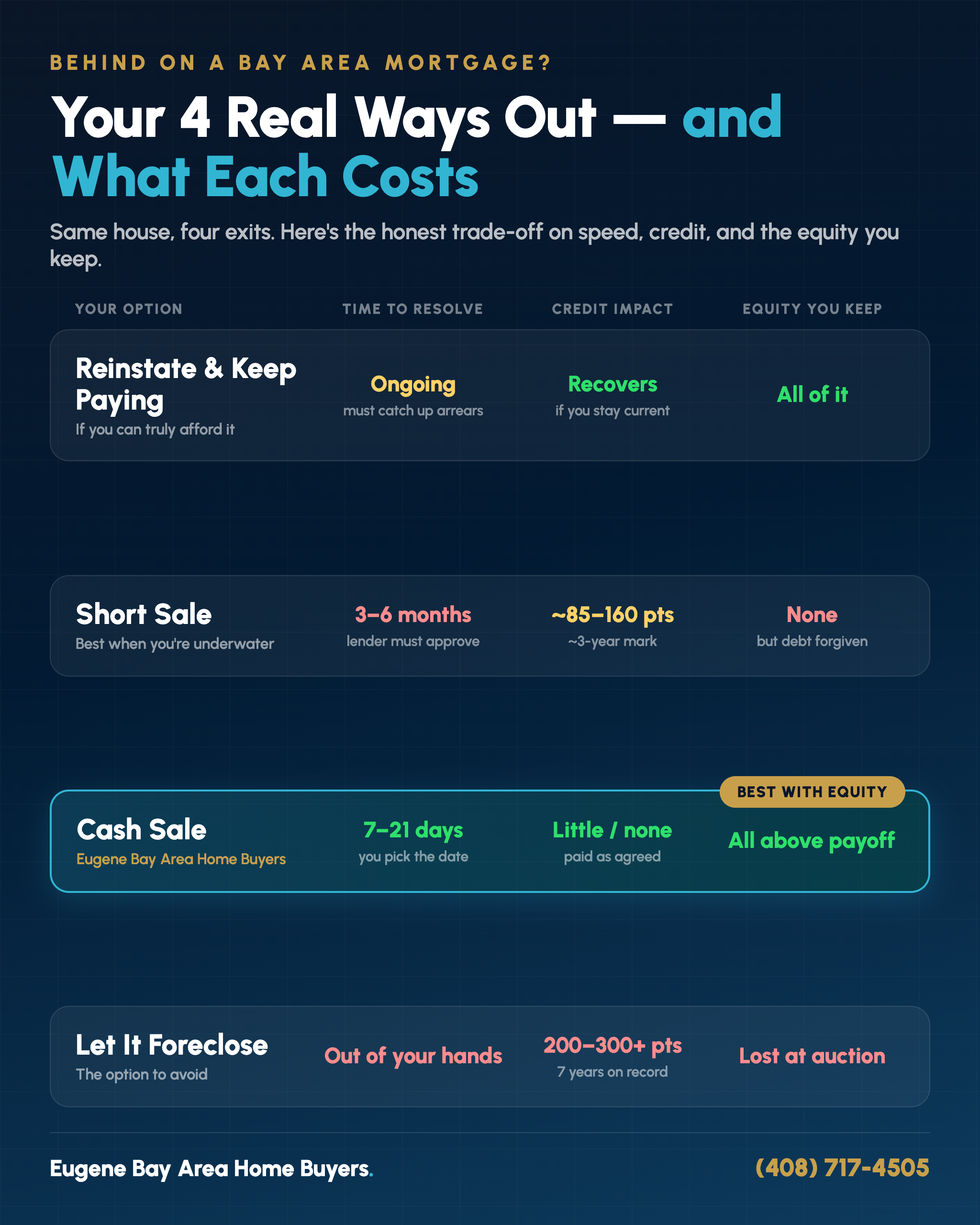
1. Reinstate and keep the home
If the hardship was temporary and you can realistically afford the payment again, you catch up the arrears (or negotiate a loan modification or repayment plan) and keep the house. Timeline: ongoing. Credit: recovers as you re-establish on-time payments. Catch: you have to be honest with yourself — if the payment was unaffordable before, reinstating just resets the same clock.
2. Short sale (only if you're underwater)
Negotiate the lender down to accept less than the balance, as described above. Timeline: 3–6 months, sometimes longer. Credit: a meaningful hit (commonly an 85–160 point drop) that typically clears faster than a foreclosure — often around three years before you can finance again. Catch: it's slow, the lender controls it, and it only works if you truly have no equity.
3. Cash sale (the fastest way to protect equity)
If you have equity, you don't need anyone's forgiveness — you need speed. Sell the home for cash, the mortgage and any tax lien or HOA lien get paid off at closing, and every dollar above those payoffs is yours. Timeline: 7–21 days. Credit: little to none — the loan is paid as agreed, so no short-sale or foreclosure mark. Catch: a cash offer is below full retail, so if your home is market-ready and you have months to spare, a traditional listing may net more (we're honest about that in the math below and in our breakdown of a cash offer vs. listing with an agent).
4. Let it foreclose (the one to avoid)
Do nothing and the lender forecloses. California's non-judicial foreclosure runs roughly 120–150 days from the Notice of Default to the auction. Credit: a 200–300+ point drop that stays on your record for seven years. Catch: any equity you had is consumed by fees and a distressed auction price. There's almost never a scenario where foreclosure beats acting — our guide on how to stop a foreclosure in California covers the time-critical version of this.
Real Oakland math: what "short sale" actually costs when you have equity
Numbers make the reframe concrete. Take a real-feeling case: an Oakland home worth about $720,000, with a $560,000 mortgage balance and about $26,000 in missed payments, late fees, and a small HOA balance. You're five months behind and panicking about a "short sale."
But look at the equity: $720,000 minus $586,000 in total debt is roughly $134,000 that belongs to you. You're not underwater at all — so a short sale isn't even available. Here's how the realistic paths compare:
Path A — You let the panic win and the home forecloses
- Auction price (distressed, below market): ~$650,000
- Lender payoff + fees + foreclosure costs: −$600,000
- Whatever's left after the auction trustee's fees: a few thousand, if anything, often delayed for months
- Credit: 200–300+ point drop, seven-year mark
- You keep: almost none of your $134,000 — and your credit is wrecked.
Path B — You sell to a cash buyer in two weeks
- Cash offer (as-is, no repairs): $675,000
- Mortgage + arrears + HOA paid at closing: −$586,000
- Repairs, commissions, closing costs: $0 (we cover closing costs; no agent commission)
- Time to close: ~14 days
- You keep: ~$89,000 in cash — and avoid a foreclosure on your credit entirely.
A polished MLS listing might fetch more than $675,000 on the top line — but only if you have 60–90 days you don't have, the home shows well, and the sale doesn't fall out of escrow while the foreclosure clock keeps ticking. The point of the comparison isn't that cash always nets the most dollars; it's that when you're behind with equity on the line and time running short, the fast, certain path is what actually protects the money. The word "short sale" was never the right tool for this situation.
Special situations
You have a second mortgage or HELOC
A second lien complicates a short sale — both lenders have to agree, and the second often holds out for a payment to release. If you have equity, this is far simpler: both get paid at closing. Layered liens like a tax lien or HOA lien are handled the same way, in closing-priority order.
You're also in (or considering) bankruptcy
Bankruptcy and a home sale interact in specific ways — an automatic stay can pause a foreclosure, but selling usually requires trustee or court coordination. See our guide on selling a house during bankruptcy in California before you assume the two cancel each other out.
The home has a reverse mortgage
If you inherited a home with a HECM that's underwater, there's a specific FHA short-sale path (sell at 95% of appraised value, the insurance covers the rest, you owe nothing). Our reverse-mortgage heirs' guide walks through that clock in detail.
You're underwater AND out of time
This is the one case where a short sale and a cash buyer work together: an experienced cash buyer can make an offer the lender accepts for short-sale approval, then close fast once it clears. If a Notice of Default is already recorded — common in Richmond and Vallejo, where more homes carry thin equity — start immediately; the lender's approval timeline is the bottleneck.
Frequently asked questions
Short sale vs. foreclosure in California — which is worse for my credit?
Foreclosure is meaningfully worse. A short sale typically drops your score 85–160 points and clears faster, while a completed foreclosure drops it 200–300+ points and stays on your report for seven years — and future mortgage lenders treat a recent foreclosure as a major red flag for years. Between the two, a short sale wins. But if you have equity, a normal or cash sale that pays the loan as agreed beats both, because it leaves almost no negative mark at all.
How long does a short sale take in California?
Plan on 3–6 months, sometimes longer. The slow part is lender approval — the servicer, and often an investor or mortgage insurer behind the loan, has to sign off on accepting less than the full balance. That's why a short sale is a poor fit if a foreclosure auction is close: you may run out of runway before approval comes through.
Will I owe the bank money after a short sale?
Usually not, on a primary residence. Under California Code of Civil Procedure §580e, once a lender approves a short sale on a 1–4 unit residential property, they generally can't chase you for the forgiven deficiency. Second mortgages and HELOCs can have different rules, so get the release-and-no-deficiency language in writing and have an attorney review it.
Do I have to be behind on payments to do a short sale?
Not strictly, but lenders rarely approve one without a documented hardship and a home that's genuinely underwater. If you're current and have equity, you don't need a short sale — you can simply sell.
Can I sell to a cash buyer instead of doing a short sale?
Yes — and if you have equity, that's usually the better move. A cash sale closes in 7–21 days, pays off your mortgage and any liens, and puts the remaining equity in your pocket without the months of lender negotiation a short sale requires. If you're underwater, a cash buyer can still help by anchoring the short-sale offer your lender approves.
How do you calculate a cash offer on a home I'm behind on?
The same way we calculate any offer: the home's after-repair value, minus repair and holding costs, minus our selling costs and margin. Being behind on payments doesn't lower the offer — we're buying the house, not underwriting you. See how cash home buyers calculate offers for the full breakdown.
The honest bottom line
A short sale is a legitimate, California-protected way out — but it's the right tool for a narrow situation: you're underwater, you have a documented hardship, and you have the months it takes for a lender to approve it. For most Bay Area homeowners who fall behind, none of that is true. They have equity, and they have weeks, not months — which means the real choice is between protecting that equity with a fast sale or losing it to a foreclosure.
If you're not sure which camp you're in, that's the first thing worth finding out, and it takes one phone call. Tell us the address and roughly what you owe, and we'll tell you honestly whether you're underwater (short-sale territory) or sitting on equity (sell-fast territory) — and if listing with an agent would genuinely serve you better, we'll say so. Call (408) 717-4505 for a free, confidential, no-obligation conversation. We buy across the Bay Area, including Oakland, Richmond, and Vallejo — and when the foreclosure clock is running, our Bay Area foreclosure cash-buyer page is the fastest way to a written offer.


