The forbearance is over. The letter says the paused payments are now due, the regular payment restarts this month, and the arrears figure at the bottom is larger than any check you could write. So you go looking for help — and every page that ranks is national and institutional: the CFPB, Rocket, HUD, Bank of America, Fannie Mae, Freddie Mac. All of them explain what forbearance is.
Almost none of them answer the question people actually arrive with, which is the one on the other side of it: the forbearance has ended, the arrears are sitting there in a lump, and the monthly payment still doesn't work. Nothing in this article is legal or financial advice — talk to a HUD-approved housing counselor, which is free — but this is the honest sequence of what happens next in California, what your servicer owes you, how much time you really have, and the option nobody at the bank is going to raise with you.
First: you almost certainly do not owe it all at once
This is the single most common and most damaging misunderstanding at this stage, and it drives people into panic decisions in week one.
A forbearance pauses payments; it does not forgive them. But for most loans — and particularly for federally backed ones — a lump-sum repayment is not the only option, and the servicer is generally required to evaluate you for alternatives before proceeding to foreclosure. The usual menu, roughly in order of how easy it is to qualify for:
- Reinstatement. You pay the whole arrears figure now and the loan is current again. Best if the money exists.
- Repayment plan. The arrears get spread across your next several monthly payments. Your payment goes up temporarily. This only works if your income has genuinely recovered.
- Payment deferral or partial claim. The missed payments get moved to the back end of the loan — due at payoff, sale or refinance — and your regular payment resumes unchanged. This is the option most people are hoping for and most don't know to ask for by name.
- Loan modification. The terms themselves change: rate, term, sometimes principal. Slowest to process, but the only one that helps when the payment was already beyond you before the forbearance.
Ask your servicer, in writing: "Which loss-mitigation options does my loan type qualify for, and can you evaluate me for a payment deferral or partial claim?" Then ask for the answer in writing too. Verbal answers from call centers are worth what you paid for them.
What California gives you that the national articles leave out
California's Homeowner Bill of Rights adds protections on top of the federal rules, and they matter enormously at exactly this moment:
- Contact before default. Your servicer generally has to contact you — or make documented attempts — to discuss your options, and then wait a period after that contact before recording a notice of default. The foreclosure cannot simply start silently.
- A single point of contact. You are entitled to one identifiable person or team who knows your file, rather than starting from scratch with whoever picks up.
- No dual tracking. While a complete first-lien loss-mitigation application is pending, the servicer generally cannot push forward with recording a notice of default or holding a sale. The word doing the work there is complete — an application missing one document is not pending, it is in limbo.
- A written denial, and an appeal. If you are turned down, you are entitled to the reason in writing, and there is an appeal window.
The practical takeaway is unglamorous: apply completely, apply early, and keep a paper trail. A complete application is not just paperwork — under these rules it is what holds the foreclosure clock still while you are being considered.
How much time you actually have
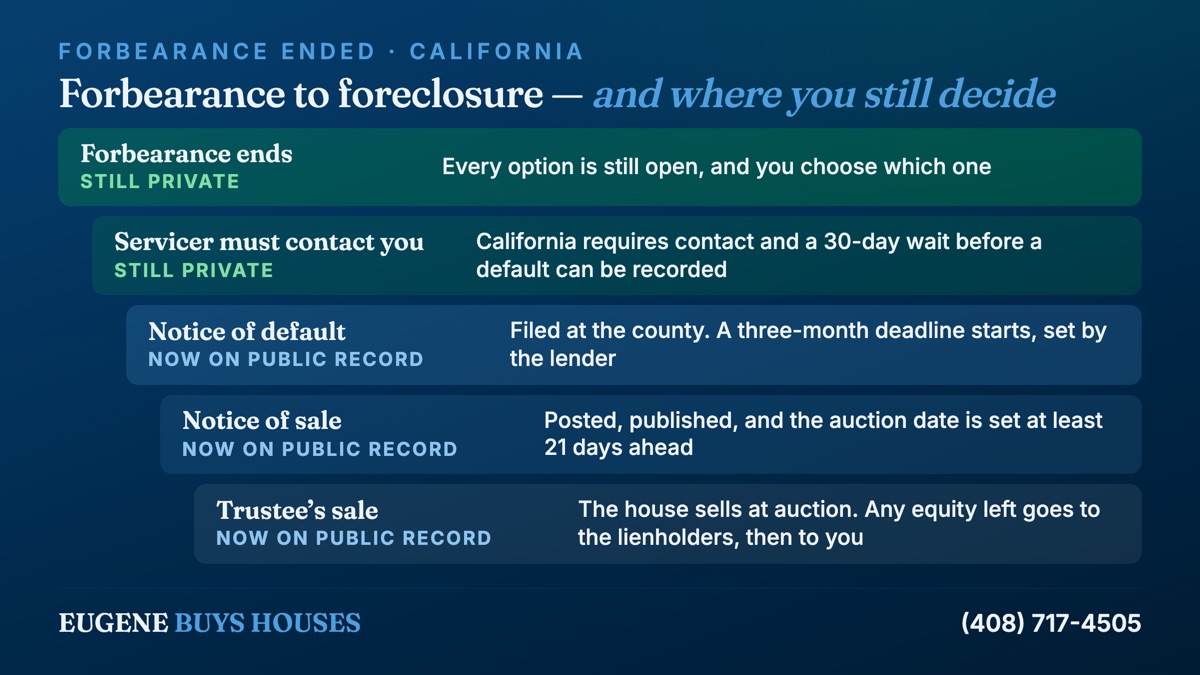
Once a notice of default is recorded, California's nonjudicial foreclosure runs on a fixed statutory minimum: at least three months before a notice of sale can be recorded, then a sale set at least 21 days out. That is roughly four months from recording to auction as an absolute floor, and in practice sales are postponed and it usually runs longer — the whole clock is mapped in your options in California pre-foreclosure.
Add the servicer-contact period that comes before the notice of default, and a homeowner who acts the week the forbearance ends typically has several months of real runway. That is enough time to apply for a modification and — critically — enough time to sell the house properly if the modification doesn't land.
What burns the runway is silence. The clock does not care that you are waiting to hear back, and the worst position to be in is negotiating a sale with a trustee's sale date already published.
The honest part: when the options don't fix it
Loss-mitigation options solve a temporary shortfall. They are built for the homeowner whose income stopped and restarted. They do not solve a permanent one.
So do this arithmetic before you spend three months on an application:
- Take your current, realistic monthly income.
- Subtract the mortgage payment you would have after the best realistic outcome — a deferral that resumes your old payment, or a modification that shaves some of it.
- Subtract property taxes, insurance, HOA, utilities and the rest of life.
If that number is still negative, a modification does not rescue the house. It buys nine months and then you are here again, with nine months of additional arrears, less equity, and a notice of default on the county record. Being clear-eyed about this in month one instead of month ten is worth more than any single strategy on this page.
The option the servicer will not raise: sell while you still control it
Your lender's loss-mitigation department exists to keep the loan performing. It is not their job to point out that you own an asset that, in the Bay Area, has very likely appreciated substantially since you bought it.
Here is why selling before a notice of default is materially different from selling after one:
- You keep the equity. A trustee's sale pays the lienholders first, and equity is routinely lost at auction because nobody at that auction is trying to get you a good price. A normal sale pays off the loan and wires the remainder to you.
- Nothing lands on the public record. No notice of default, no notice of sale, no foreclosure on your credit report. That is the difference between a hard year and a seven-year mark.
- You choose the buyer and the date. Including a date far enough out to find somewhere to live.
- No pressure premium. A house sold with a published auction date attracts exactly the kind of buyer you would rather not be negotiating with.
Run the numbers honestly: as-is value today, minus the full payoff including arrears and fees, minus any second mortgage or lien. If that is positive by a meaningful amount, selling is a real option and it is yours alone to take. Our worked breakdown of what a fast as-is sale actually pays is in how much cash home buyers pay in the Bay Area, and the full ranking of every route by elapsed days is in how to sell a house fast here.
If the number is negative, you are in different territory — a short sale or, as a last resort, a deed in lieu of foreclosure, which pays you nothing and which California law treats less kindly than most people assume.
Four things not to do
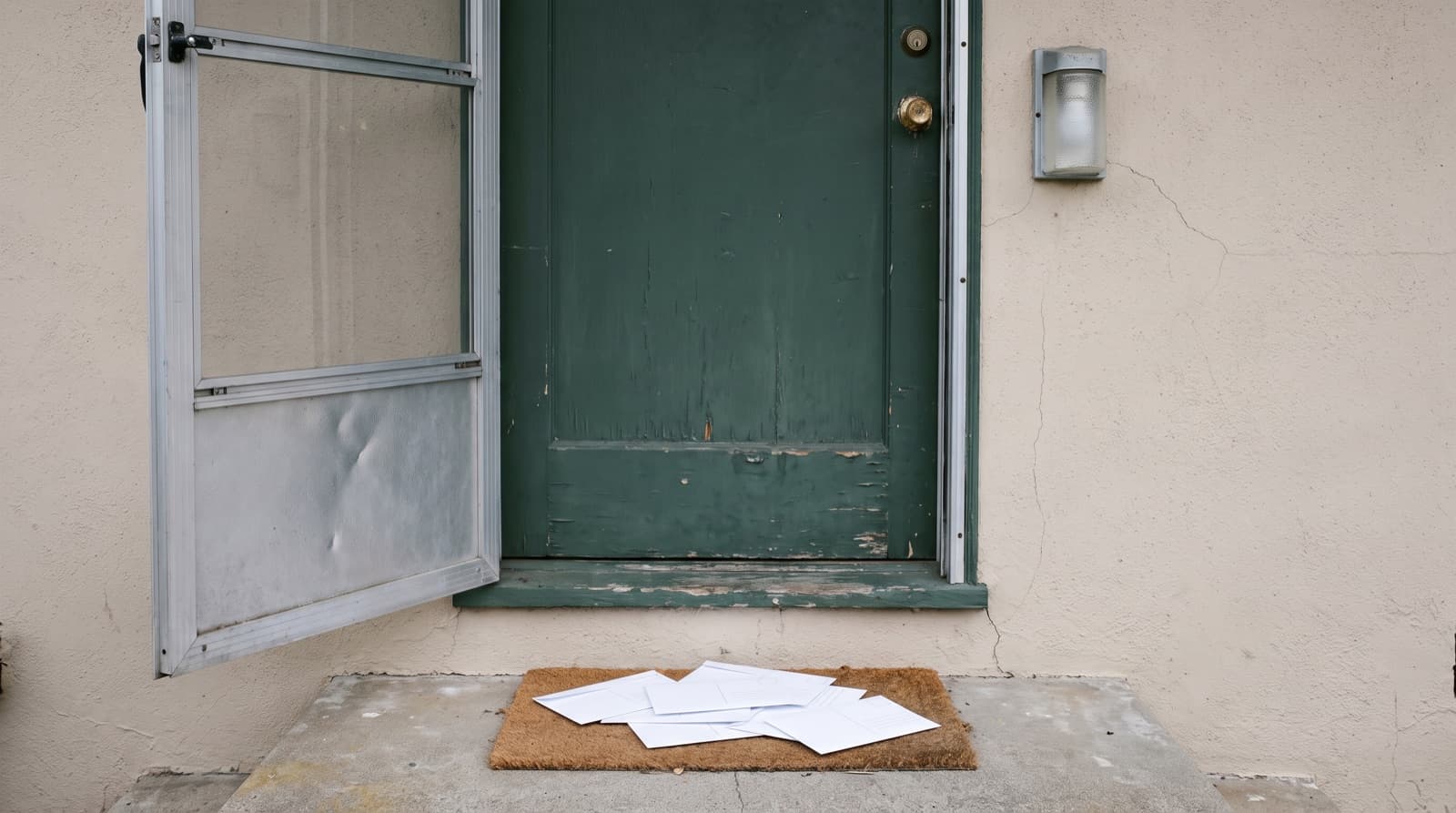
- Don't go quiet. Unopened mail is how a manageable situation becomes a recorded one. Everything on this page gets harder after the notice of default.
- Don't pay anyone up front to "save" your house. California law restricts what a foreclosure consultant may charge and when — advance fees for this kind of service are a bright red flag, and the legitimate equivalent, a HUD-approved housing counselor, is free.
- Don't sign the deed over to a "rescue" investor who promises to let you rent it back. This is the oldest equity-stripping structure there is. California has specific protections for home-equity sales on homes in foreclosure, including a cancellation right — if someone is steering you around a normal escrow, stop and get a lawyer.
- Don't walk away from a house with equity. Handing back a Bay Area house that is worth more than the loan is the most expensive move available, and it is the one people make when they are exhausted rather than informed.
What to do in the next 14 days
- Get the exact numbers in writing. Total arrears, a reinstatement quote, and the current payoff. Ask for all three by email.
- Ask which loss-mitigation options your loan qualifies for, naming payment deferral and partial claim specifically.
- Call a HUD-approved housing counseling agency. Free, independent, and they deal with servicers daily. This is the single highest-value hour available to you.
- Submit a complete application — every document, at once — and get written confirmation that it is complete.
- In parallel, find out what the house is worth as-is. Not to sell it; to know whether you have a second option. It is free, and having a number changes how you negotiate with the servicer.
Steps 4 and 5 are not in conflict. Applying does not commit you to selling, and knowing your equity does not commit you to anything at all.
Questions California homeowners ask after forbearance
Do I have to repay forbearance in a lump sum?
Usually no. For most loans, and particularly federally backed ones, the servicer is required to evaluate you for alternatives such as a repayment plan, a payment deferral or partial claim that moves the arrears to the end of the loan, or a modification. Ask for those by name and get the answer in writing.
Does forbearance hurt your credit?
An approved forbearance is generally reported as current rather than delinquent while you are in it. What damages your credit is what happens after it ends — missed payments outside the plan, and any foreclosure that follows.
What happens the day forbearance ends?
Your regular payment resumes and the accumulated arrears become due under whatever repayment arrangement you and the servicer agree. If you agree to nothing, the account goes delinquent and the pre-foreclosure process eventually begins.
How long before they can foreclose in California?
Your servicer must contact you about your options and wait a set period before recording a notice of default. After that, at least three months before a notice of sale, and at least 21 more days before the auction. Realistically that is several months from the first missed payment — but only if you use them.
Can I sell my house while I'm in forbearance or behind?
Yes. You own the house until a trustee's sale happens. Escrow orders a payoff demand from your lender, the loan is paid in full at closing, and anything left over is yours. Nobody needs the servicer's permission unless the sale price won't cover the payoff, which is what makes it a short sale.
Can I get a second forbearance?
Sometimes, depending on the loan type and how much forbearance you have already used. It is worth asking — but treat it as more time to decide, not as a solution, unless your income is genuinely about to recover.
Will a loan modification lower my payment enough?
It depends entirely on how far short you are. Modifications typically adjust rate and term; that can close a modest gap and rarely closes a large one. Do the arithmetic above before you invest months in the application.
Know your number before you decide
Whatever you do next — modification, deferral, sale — the decision is better with one figure in front of you: what your house is worth today, as-is, against what you owe including the arrears.
We will give you that number free, with no obligation, usually within 24 hours of seeing the house, anywhere in the Bay Area including Antioch, Pittsburg and San Leandro. Call (408) 717-4505. If the modification is your better path, we will say so and you will have lost nothing but a phone call — and if you would rather work through every option first, how to stop a foreclosure in California lays out all five.